How to Play the Wedding Shoe Game (Setup, MC Script, and the Pre-Game Checklist Most Receptions Skip)
Beyond the standard back-to-back setup — the full MC script template, four prop alternatives for couples whose shoes won't work, and the deep-cut recovery move every MC eventually needs.
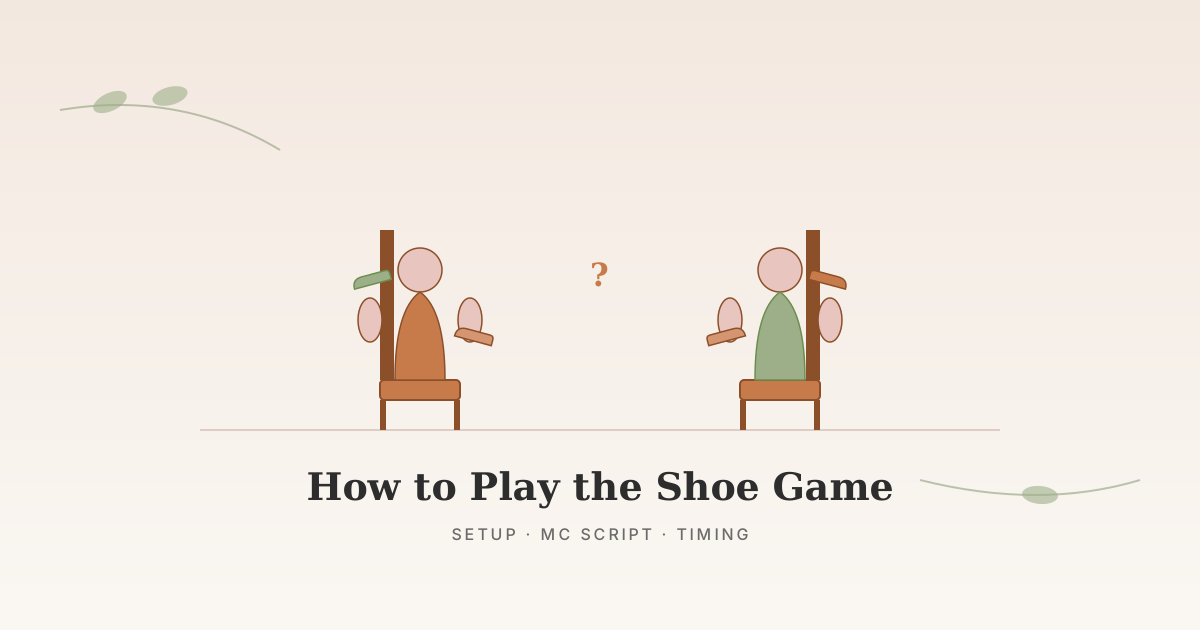
The wedding shoe game lives or dies on the MC’s first 90 seconds — long before any question is asked. Standard how-to-play guides give you the setup (back-to-back chairs, swap shoes, lift the one that fits the answer), but every couple who’s played a flat shoe game can tell you the format alone is no guarantee. Below: the full MC script template, four prop alternatives for couples whose shoes won’t cooperate, the “deep cut” recovery move, and the pre-game seating + audio checklist most receptions skip.
The setup, in 60 seconds
- Two chairs, back-to-back, in the centre of the dance floor. Microphone for the MC. Mic stand or a second handheld for the couple if you want their reactions audible (recommended).
- Couple sits down. Each removes one shoe (any shoe; doesn’t matter which foot) and trades it with their partner. Each person now holds one of their own shoes and one of their partner’s shoes.
- MC asks “Who is X?” The couple raises whichever shoe matches the answer in their opinion.
- The funniest moments are mismatches. The MC pauses on those, lets the room react, then moves on.
The MC script that warms the room first
Most MCs jump straight to question one. The version that actually works frames the game out loud so guests know what they’re watching for. Adapt this script — keep the cadence, swap the names:
“Alright. Sarah and Mike, take a seat. The way this works: I’m going to ask a question, you raise the shoe of whoever fits the answer best. If you agree, two of the same shoe go up. If you disagree —” (beat) “— that’s the part the rest of us came for.”
“Quick rules. No looking. No talking to each other. And if I ask a question and you don’t know the answer — just raise a shoe and commit. The game punishes hesitation. Ready? Question one.”
Three things that script does that off-the-cuff openings don’t: it tells the audience what to watch for (disagreements), it tells the couple what behaviour to avoid (hesitation), and it sets the comedic register. The room relaxes. The game lands faster.
Four prop alternatives when shoes won’t work
- Paddles. One side red, one side black — or pick two contrasting colours from the wedding palette. The most visible alternative from the back of the room. Best for venues over 150 guests where shoes read small.
- Small flags. Two colours, one in each hand. Same logic as paddles, slightly more elegant for formal weddings.
- Hands raised, left or right. The lowest-tech version. Works if the couple has limited mobility or the dress / suit makes bending awkward. The MC pre-assigns “left hand = Sarah, right hand = Mike.”
- Phones with photos on the screen. Photo of each partner on each phone. Lift the one that fits. Slightly clunky logistically but very photographable for social.
Pre-game checklist — what most receptions skip
- Seating placement. Centre the chairs so all four sides of the room can see at least one of the couple in profile. Putting the chairs against a wall leaves half the room watching backs of heads.
- Audio for reactions. The couple’s ad-libbed responses (laughs, ohhs, the occasional “wait, really?”) are half the entertainment. If only the MC has a mic, those are inaudible past row two. Two handhelds on chairs or two lavaliers solves it.
- Question pre-screening. The MC reads the question list privately before the reception and cuts anything that targets a sensitive topic (the couple’s first marriage, a recently deceased relative, a financial sore point). The couple does NOT see the list.
- DJ cue. A short drum-roll or sting between questions keeps energy up — saves ~8-12 seconds of dead air per question, which adds up over 20 questions.
- A wind-down question. End with one warm, unanimous question (“who’s gonna make a great parent / spouse / partner?”) so both shoes go up together. The bit closes on a laugh-plus-aww, not a mismatch.
The deep-cut recovery move
Sometimes a question cuts deeper than intended (“who’s more likely to file for divorce first?” — a real question some lists include). If the couple visibly stiffens, the MC should drop the question with one line and move on: “Cutting that one — wrong room, wrong day. Next.” The room laughs at the self-awareness; the momentum stays. The worst move is to push through. The second worst move is to apologise for a sentence longer than “next.”
Timing in the reception
Post-dinner, pre-dancing. 15-20 questions, roughly 30-45 seconds per question with reactions = 8-12 minutes total. Place it after the speeches but before the formal dances. A common mistake: scheduling the shoe game after the dance floor opens — once guests are dancing, getting them re-seated to watch is a logistical fight, and the game lands flat in a half-empty room.
Generate your question list
For a personalised list of 30-50 questions tailored to the couple’s names, years together, and chosen rating, use the wedding shoe game questions generator — pick G, PG, PG-13, or R and it produces a print-ready set plus MC cue cards. For a curated list of 60 funny questions organised by rating with notes on which audiences each tier fits, see 60 funny wedding shoe game questions.
FAQ
How long does the shoe game take?
15-20 questions at roughly 30-45 seconds each, reactions included — about 8-12 minutes total. Place it post-dinner, pre-dancing; once the dance floor opens, re-seating guests to watch is a fight and the game lands flat.
What if the couple can’t or won’t use shoes?
Swap in paddles (best for 150+ guest rooms), small flags, hands raised left/right (lowest-tech, best for mobility limits), or phones with each partner’s photo on screen. Same MC script, same mechanics — only the prop changes.
What if a question lands badly?
Drop it in one line — “Cutting that one — wrong room, wrong day. Next.” — and move straight to the next question. The room laughs at the self-awareness. Pushing through, or apologising at length, is what actually kills the momentum.
More shoe-game guides
This page covers the mechanics. For a specific rating, audience, or reception type, these go deeper:
Question banks by tone
- 60 funny questions, sorted G to R — the audience-fit matrix for picking a rating.
- Dirty questions, and which ones backfire — for after-parties and bachelor/ette nights.
Special situations
Hosting & alternatives
- 4 ways hosts ruin the shoe game — and the fix for each.
- 5 alternatives — for when the shoe game isn’t the right fit.
Where this advice breaks
The shoe game format assumes a Western reception structure with seated guests post-dinner. It transplants poorly into weddings with continuous service (Indian baraat-and-on, Persian sofreh-led receptions) where the “everyone seated and watching” window doesn’t exist. For those, swap the shoe game for a quiz the MC reads between courses — the same content, different staging. The other non-fit: very small weddings under 25 guests, where the intimacy of the room makes the “mismatch reveal” feel more exposing than funny.