Should You Send a Gift After Declining a Wedding? (And How Much?)
A relationship-tier dollar matrix for declined-guest gifts, three scenarios that flip the answer, and the gift-vs-presence trade-off — actionable specifics other guides skip.
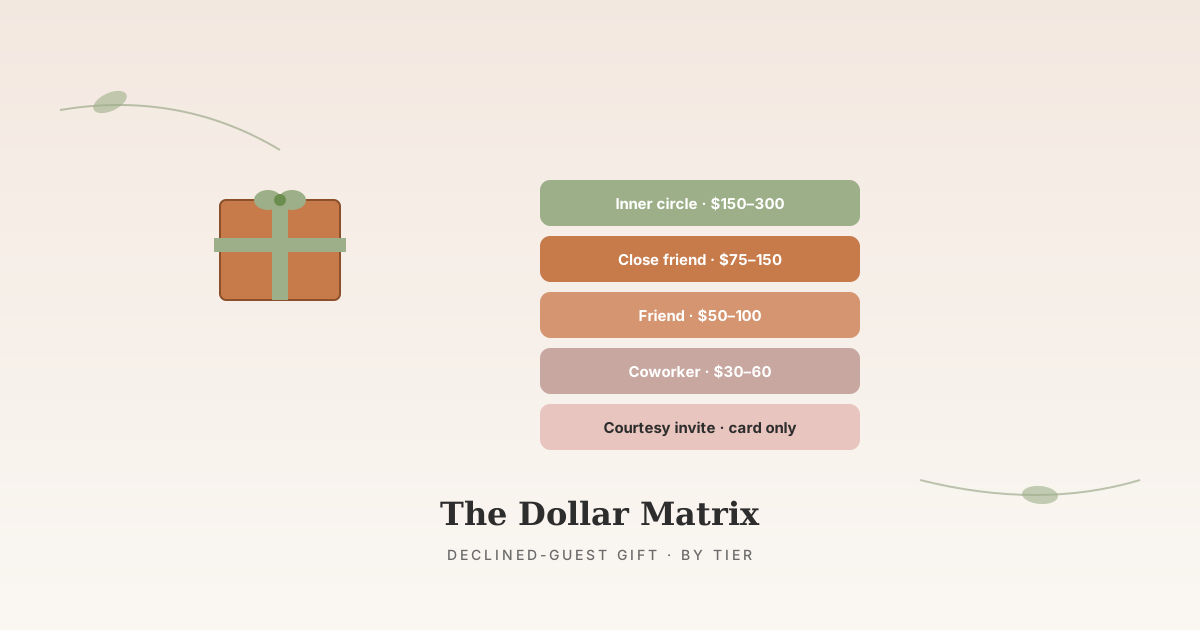
Standard advice on sending a gift after declining a wedding says “a gift isn’t required, but it’s thoughtful if you’re close.” That isn’t actionable. Most of the people Googling this are mid-tier — not close, not strangers — and the “close” dial doesn’t resolve the question. Below: a relationship-tier dollar matrix with specific amounts, the three scenarios where the answer flips, and the gift-vs-presence trade-off most decline guides skip.
The dollar matrix
Numbers are 2025 US-default ranges. Adjust for region (NYC / SF +20-30%, smaller metros -10-20%) and your own financial situation — these are upper-comfortable, not minimums.
| Relationship tier | Send a gift? | Amount | Form |
|---|---|---|---|
| Immediate family | Yes, always | $150–300 | Registry item or cash |
| Inner-circle friend (would have stood up) | Yes, always | $100–200 | Registry, ideally something they specifically picked |
| Close friend (regular contact) | Yes | $75–150 | Registry or thoughtful non-registry |
| Friend (irregular contact) | Yes, smaller | $50–100 | Registry low-end item |
| Coworker / acquaintance | Optional | $30–60 | Card + small registry item |
| Courtesy invite (B-list, distant) | No | — | Warm card only |
Notable: even at the highest tier, you’re not expected to send the “cost of your plate” — that’s the rule for attending guests. Declined-guest gift sizing runs roughly 60-70% of what you’d give if attending. Couples know the difference.
Three scenarios that flip the answer
Flip 1: You’re declining because of money
If the reason you’re saying no is that you can’t afford the travel / hotel / outfit, do not send a gift on top of that. The couple knows the math. Sending a $150 gift because you couldn’t fly out for $600 reads as performative. A genuinely warm card and a follow-up dinner when they’re back is the entire response — no gift needed. The couple will understand and not score you for it.
Flip 2: The wedding is destination, you’re B-list
Destination weddings widely accepted that the cost-to-attend IS the gift. If you weren’t expected to fly to Italy in the first place, declining doesn’t create a gift obligation. Even at moderate-friend tier, a small registry item ($40-60) discharges the social debt completely. Don’t feel pressured to send the full amount.
Flip 3: There’s active distance / fall-out
If you’re declining because the relationship has genuinely cooled — old friendship that’s drifted, family member you’ve grown apart from — don’t reset the relationship via a gift. A warm card without a gift is the right form. A large gift signals “I’m investing in this relationship,” which then has to be sustained. If the answer is honest distance, let the card carry it.
Gift vs presence — the trade-off most guides skip
The thing the couple will actually remember six months on isn’t the gift amount — it’s whether you showed up for them after the honeymoon. A $50 gift plus a coffee date when they’re back is worth more than a $200 gift and silence. Build it into the decline:
- Pre-honeymoon (now). Send gift + handwritten card. Card mentions the post-trip plan: “Can’t wait to hear everything when you’re back — let me know when you’re free and dinner’s on me.”
- Day-of-wedding. Send a single short text the morning of: “Thinking of you today. Have the best one.” Costs nothing, lands hugely.
- 2-3 weeks after. Actually book the dinner. The follow-through is what maintains the relationship; the gift just lubricates the moment. Skip the follow-through and the gift becomes a transactional “sorry.”
How to write the decline card
Three sentences max. Lead with warmth, name the reason briefly (one phrase, not a paragraph), close with a future-tense commitment. The decline generator renders three versions side-by-side (safe / honest / diplomatic) plus a believability score that catches over- explaining. For the broader decision tree on whether to decline at all, see can’t attend a wedding decision framework, and for the decline itself, see how to politely decline a wedding invitation.
Where this matrix breaks
The dollar ranges assume US/Canadian default registry norms. Cash-gift cultures (most South Asian, many East Asian, many Eastern European weddings) operate on a different scale — gift envelope size correlates more tightly with relationship and family expectation, and the matrix above will read low. Defer to family elders for amount calibration in those contexts. Second exception: workplace weddings where multiple coworkers contribute to a group gift — your share is proportional to the group, not the matrix above. A $30 contribution to a group $300 gift is the right scale.