When Your Family Is the Bridezilla: Handling Mom-of-the-Bride and MIL Demands
Why controlling mom and controlling mother-in-law need different scripts. Four demand categories, two scripts, and the moment to stop negotiating.
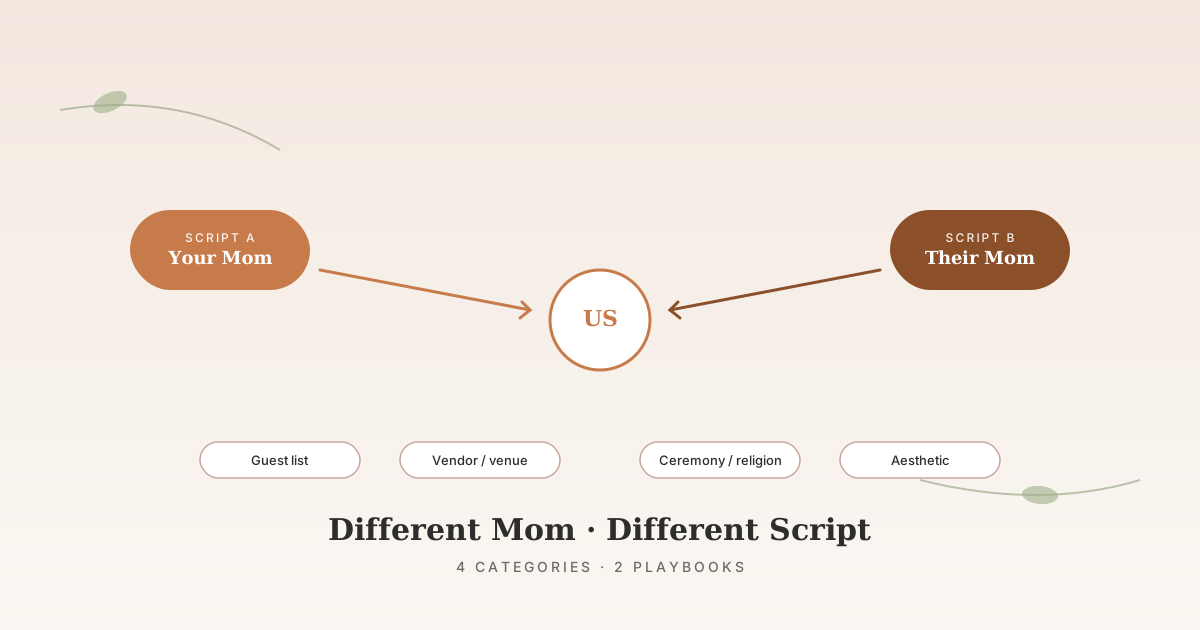
A controlling mother-of-the-bride and a controlling mother-in-law need different scripts — the dynamic, the leverage, and the failure modes are not the same. Standard “Momzilla” advice treats family pressure as one bucket and offers the same boundary-setting line for all of it. It doesn’t work. Below: the four demand categories you’re actually fighting, the two scripts (one for your mom, one for theirs), and the moment to stop negotiating.
Why your mom and their mom need different scripts
Your own mother has lifelong relational capital. She can push harder because she trusts that you will not actually go scorched earth. The conflict pattern is intense, sometimes tearful, usually reconcilable. Your future mother-in-law has no such capital with you — but she does with your partner. The leverage path runs through them. So the “handle it” channel is different: with your mom, you negotiate directly. With your MIL, your partner is the front line and you are second-chair. Getting this wrong creates the worst version of wedding-planning family drama.
The 4 demand categories
- Guest-list demands. “You need to invite my cousin’s family.” “Your father’s old colleagues.” The fight where money usually surfaces — the parent contributing assumes guest-list influence comes with the cheque. Highest frequency, second-highest emotional weight.
- Vendor / venue demands. “We’re using my caterer.” “The church must be ours.” Often tied to family tradition or a specific person the parent wants to honour. Easier to redirect than guest list.
- Ceremony / religious demands. “A priest must officiate.” “You must have a [tradition].” Highest emotional weight, lowest frequency. Often the fight that produces the biggest long-term family fracture if forced through over the couple’s objection.
- Aesthetic demands. “Not those flowers.” “Not that dress.” Loudest but lowest stakes. Usually a stand-in for the parent feeling un-needed — see the script below.
Script A — for your own mother
Have it in person, one-on-one, in her space. The frame is warmth + clarity, not boundary-language pulled from a therapy article. Pulling language she doesn’t recognise will escalate, not de-escalate.
“Mom, I want to talk about [specific demand]. I know this matters to you. I’ve thought about it and the answer is going to be [no / yes with this change / not this way]. What I’d love is for you to own [specific alternative task] — that’s a real piece of the wedding and it’s yours.”
“If you push on this one, it’s going to be a fight neither of us wants. I’m asking for the no on this. I’m still asking for your help on [other piece].”
Two things this script does that generic advice doesn’t: it offers a redirect (the alternative task), and it names the cost of the fight out loud so she has to weigh it. The redirect is critical. Most controlling-mom behaviour comes from feeling sidelined, not from genuine vendor opinions. The redirect addresses the underlying need.
Script B — when it’s your MIL
Your partner runs this conversation, not you. Brief them first: align on the answer, agree on the message, agree on the redirect. Then your partner delivers it. Your role is to not contradict the message later when MIL approaches you directly looking for a softer answer (she will). United front, every time.
“Mum, [partner] and I have made the call on [demand]. It’s going to be [no / different / not this way]. We’d love your help with [alternative] — that’s really yours to run. If you have feedback on the wedding, come to me, not to [partner’s name]. They are working on a hundred things and I don’t want this to land on their lap twice.”
The last sentence is the most important. It builds the channel explicitly: MIL → your partner, not MIL → you. If you become the route, the MIL becomes a wedge between you and your partner, and now the wedding has two stress fractures instead of one.
Money complicates everything (and a fix)
Most family-pressure demands escalate when the parent in question is paying. Their cheque arrives with implicit editing rights. The fix is to have the money conversation EARLY and EXPLICITLY — before specific demands surface — about whether the contribution is a gift (no strings) or a payment (strings). See the wedding budget conversation guide for the script. The four modern payment patterns also show which arrangement triggers which kind of friction.
When to stop negotiating
Two cases. First: when the demand crosses into the ceremony’s emotional core. If the parent is demanding you be religious when you’re not, or not religious when you are, or invite someone the couple has actively cut off — the conversation moves from negotiation to position. Hold the line; do not pretend a middle exists where it doesn’t. Second: when the same conversation repeats three times. After the third round, switch from negotiation mode to delivery mode — “the answer is no, I am not going to discuss this again, this is my final word.” Continuing to negotiate past round three teaches the parent that pushing eventually works.
Score what they’re actually asking
If you’re unsure whether a specific demand crosses the line, run it through the Bridezilla Score tool — although it’s framed for bridesmaids, the same cost-percentile and time-demand analytics apply to a parent. For the bridesmaid-side companion read, see is your bride a bridezilla.
Where this advice breaks
In families where the parent’s cultural authority is baked into the wedding itself — South Asian, Persian, many Mediterranean, observant religious families — these scripts misfire because the parent isn’t “controlling,” they are performing a legitimate role in the family system. The conversation here is different: it’s about which traditional elements you and your partner are choosing to honour and which you’re choosing to modify, with full eyes on the relational cost. A culturally-fluent family elder or therapist is more useful than a Western script.