Wedding Hashtag When You Already Share a Last Name (5 Strategies)
When you and your partner already share a surname, standard hashtag formulas break. Five strategies that produce unique tags, plus the surname-popularity test that picks between them.
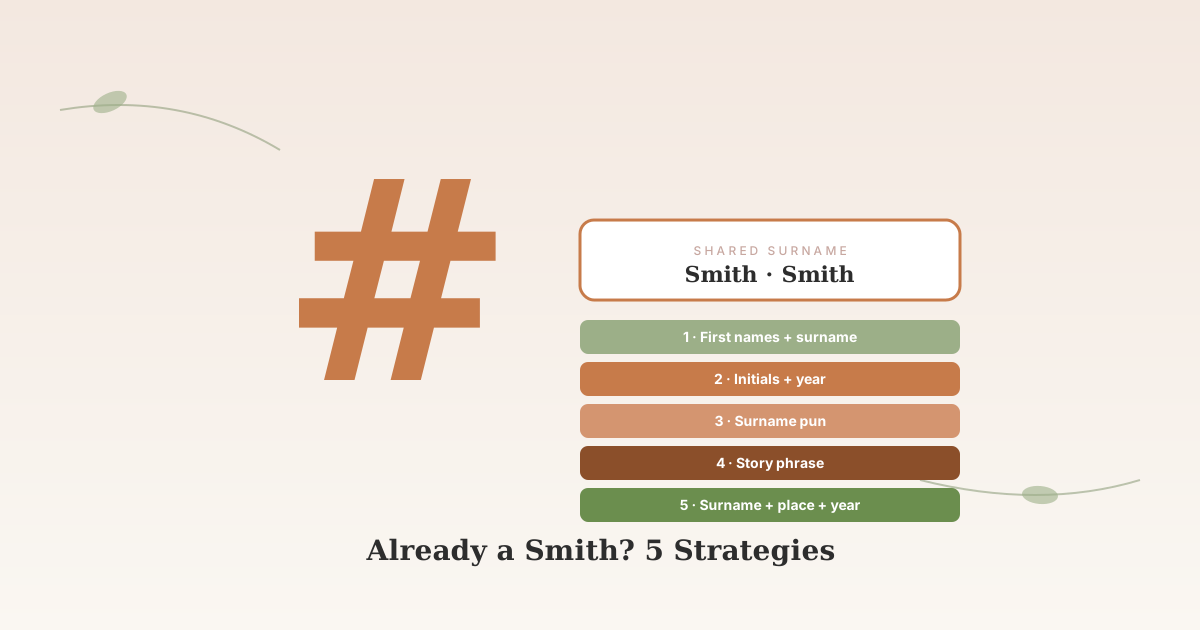
If you and your partner already share a surname, every “mash-up” hashtag formula breaks — and the obvious fallbacks (#SmithWedding) have the highest collision rate of any tag type. About 1 in 8 US couples enter marriage already sharing a surname (cousins-marrying-cousins is rare; common-surname coincidence is normal — there are 2.4M Smiths alone). Below: why the standard formulas fail, five strategies that produce a unique tag, and the surname-popularity test that picks between them.
Why the standard playbook breaks
Generators are built around mashing two different surnames (#SmithJonesUnited). With matching surnames, the formula outputs a tag identical to your partner’s already-existing Smith hashtag — and to thousands of other Smith couples marrying this year. The only path to uniqueness is to pull signal from somewhere other than the surname: first names, the date, the venue, or a phrase tied to your story.
The surname-popularity test
Before picking a strategy, check how common your shared surname is. Two quick proxies:
- US Census top-100 list. Smith, Johnson, Williams, Brown, Jones, Garcia, Miller, Davis, Rodriguez, Martinez, etc. If your surname is in the top 100, treat it as “crowded.” You’ll need two layers of specificity (first name + date, or first name + venue).
- Instagram tag-search for #Yoursurname. If > 1000 posts under your bare surname tag, treat as crowded. If < 100, you have meaningful headroom for single-layer tags.
Run the four-minute audit from how to pick a unique wedding hashtag on every candidate before committing.
5 strategies that produce a unique tag
Strategy 1 — First names + surname
Push the first names to the front. #SamAndTaylorMiller, #SamTaylorMiller2026. Works well when at least one first name is uncommon. Fails when both first names are also top-50 (a Sam-and-Taylor Miller will collide with another).
Strategy 2 — Initials + year
#STMiller2026 or #SMTM2026. Works for crowded surnames because the four-character initials + year combination is almost always unique. Reads as modern / clean. The tradeoff: guests need to be told the tag, they won’t guess it.
Strategy 3 — Surname pun
If your surname can be punned, the pun usually has less competition than the bare surname. #TyingTheKnotts, #OnceUponAGrimes, #TheHairyPotters, #UnitedTates, #MillingAbout. Best when the pun reflects something about you (the Potters who are huge HP fans, the Grimes who do horror movies). Often unique even for crowded surnames.
Strategy 4 — Story-based phrase
Drop the surname entirely. #FinallyAfterEightYears, #ItStartedAtTrivia, #ParkRangersInLove. Highest uniqueness rate of any strategy because no generator would produce it. The downside is the same as in strategy 2: guests can’t guess, so the tag must be printed everywhere (welcome sign, bar menu, photo-booth, programs, the back of the place cards — bare minimum five surfaces).
Strategy 5 — Surname + location + year
#MillersInCarmel2026, #MillersPier302026. Adds two layers of specificity. Works particularly well for destination weddings and venue-themed weddings where the location IS part of the story. Reads as natural shorthand by the wedding day.
Strategy selection by surname rarity
| Surname rarity | Recommended | Fallback |
|---|---|---|
| Top 100 (Smith, Brown, Garcia) | Strategy 2 (initials + year) or 4 (story phrase) | Strategy 5 (surname + location + year) |
| Mid-tier (1000+ IG posts) | Strategy 3 (pun) or 5 (surname + location + year) | Strategy 1 (first names + surname) |
| Rare (<100 IG posts) | Strategy 1 (first names + surname) | Strategy 3 (pun) for memorability |
Generate candidates fast
Feed both first names + your shared surname into the wedding hashtag generator — it recognises shared-surname inputs and weights strategies 1, 3, and 5 by default. For a curated list of 50 example tags by style, see 50 wedding hashtag ideas.
Where these strategies break
Two cases. First, hyphenated-surname couples (where one partner is taking the combined surname): these aren’t same-surname couples — they’re creating a NEW surname, and the standard generator approach works because the hyphenated name is fresh. Run the audit on the hyphenated version. Second, couples who are NOT taking the same surname post-wedding: don’t use surname-based tags at all. First-name and story-based strategies are stronger here — the surname will mismatch your social presence after the wedding, and the tag should reflect who you actually are.