Save-the-Date vs Wedding Invitation: What Info Goes Where
Beyond the standard comparison — the routing matrix for 12 common info pieces across save-the-date, invitation, info card, and website. Plus three tricky cases the listicles skip.
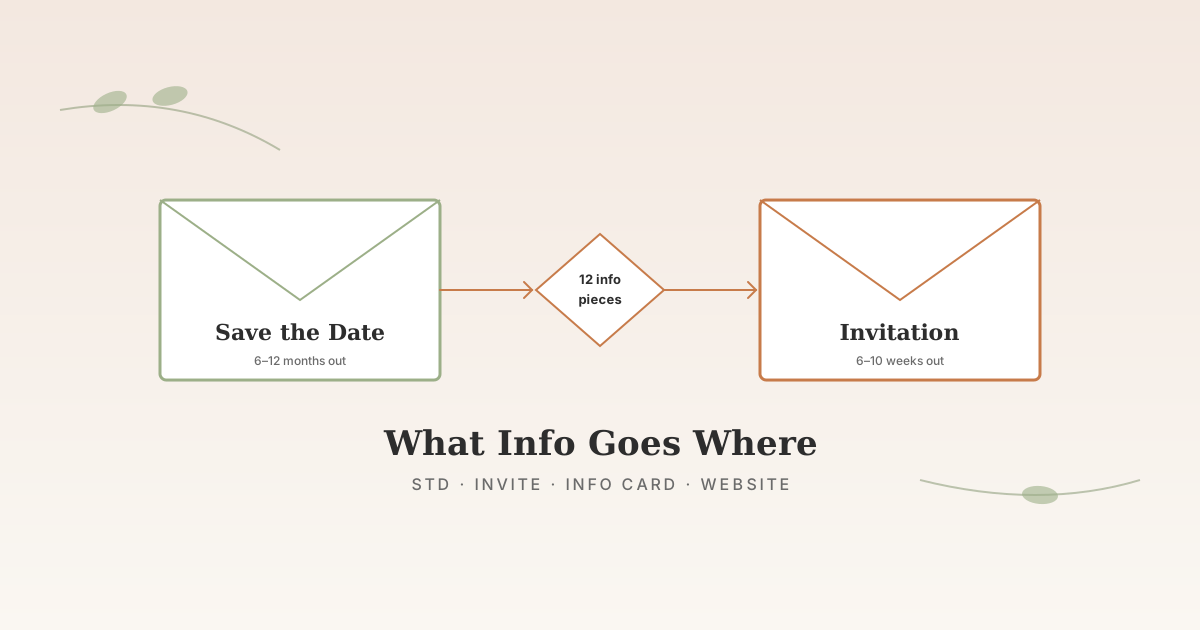
The save-the-date vs invitation distinction is well-covered. The actually-hard question — which most guides skip — is which piece of information belongs on which surface. You have four routing destinations: save-the-date, invitation, wedding website, and info card (the small enclosure inside the invitation). Below, the routing matrix for 12 common info pieces, plus the three tricky cases — venue TBD, dress code uncertain, multi-event weekend — that decide which guides are wrong on which detail.
Quick refresher (the 30-second version)
Save-the-date is a heads-up sent 6-12 months out. Invitation is the formal ask, sent 6-10 weeks out. Wedding website is the always-current source of truth. Info card is the small printed insert with the details guests need quickly without scrolling a website (parking, hotel, reception address if different). That’s the framework. Now the routing.
The 12-piece info routing matrix
| Info piece | Belongs on |
|---|---|
| Names + date | STD + invitation + website |
| City / region | STD + invitation + website |
| Specific venue + address | Invitation + website (NOT STD) |
| Ceremony start time | Invitation + website |
| Reception location (if different) | Info card + website |
| Dress code | Invitation (corner) + website (with photos) |
| RSVP method + deadline | Invitation + RSVP card OR website |
| Hotel block + booking code | Website (only); link from STD |
| Parking / transport / shuttles | Info card + website |
| Registry link | Website only (never on STD or invitation) |
| Rehearsal / welcome / brunch events | Separate inserts to invited guests + website |
| Kids / plus-ones policy | Invitation envelope (addressed names) + website FAQ |
Three tricky cases the listicles skip
Case 1: Venue isn’t booked yet at STD time
Common, especially for couples sending STDs at the 10-12 month mark before locking the venue. On the STD: date + city only (no venue). On the wedding website: a single line — “Venue details to follow.” Resist the urge to write “in the [city] area” if you’re still deciding between two cities — guests will book wrong hotels. Lock the venue before you commit to a city on the STD.
Case 2: Dress code is still being decided
Dress code goes on the invitation in tiny print at the lower right corner — “Black-tie optional,” “Cocktail attire,” “Garden formal.” Don’t put it on the STD. If you don’t know yet, the invitation can be sent without it and the wedding website can carry the dress-code-with-photo section instead. Adding dress code 4 weeks before the wedding via email blast is fine; adding it the week-of is too late.
Case 3: Multi-event wedding weekend
Welcome drinks Friday, ceremony Saturday, farewell brunch Sunday. The right move: the main invitation has Saturday only. Separate inserts go to invited guests for Friday and Sunday — different invite lists usually apply (Sunday brunch is often family + bridal party only). The wedding website FAQ explains that the weekend has multiple events and invitations differ by relationship. Mixing all three events on one invitation card forces you to invite everyone to everything, which doubles cost.
The wedding-website rule
Everything ends up on the website. The website is the only source of truth that updates — print is locked the day it prints. If a vendor changes the reception address, the address on 150 printed cards is wrong forever, but the website corrects in two clicks. Print the website URL on every paper surface (STD, invitation, info card) so guests always have the fallback.
Generate consistent wording across surfaces
For consistent wording across the STD and invitation in your chosen tone (formal, modern, fun), use the save-the-date generator — pick a template, add your names and date, export a print-ready PNG. The same tone register can carry through to your invitation wording. For 12 ready-to-copy wording templates by tone, see the save-the-date wording templates.
Where this routing breaks
For weddings under 30 guests, skip the formal STD entirely — a text or a phone call handles it. The matrix above assumes a traditional structure (STD → invitation → website) and a guest count where formal paper is worth the cost ($3-8 per guest in print + postage). Below 30 guests, the per-guest cost is high relative to the social benefit, and guests appreciate the informal touch more than the design.