Wedding Seating Chart Rules That Prevent Reception Drama
Beyond alphabetical and 'don't seat exes together' — the six high-risk relationship combinations, the resolution pattern for each, and what the singles-table debate actually depends on.
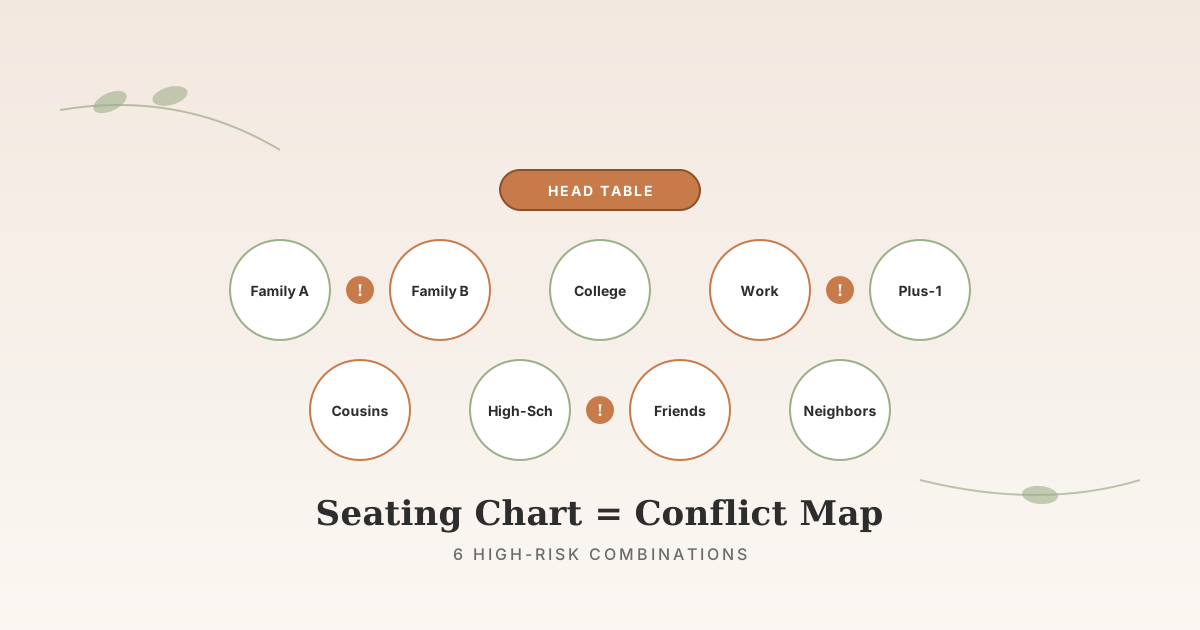
A wedding seating chart is a conflict map, not an alphabetised list. Standard guides tell you to seat people by relationship group, avoid singles tables, and never sit ex-spouses together. All true. None of them give you the actual skill — recognising which six combinations of relationships cause reception drama, and how to resolve each. The list below is what most professional planners pattern-match against in the seating review.
The six high-risk combinations
1. Divorced parents who haven’t reconciled
Blast radius: the ceremony, the head table, the first dance, the speeches, the family photos. Easily the highest-friction case.
Resolution:separate tables — one for each parent, with each parent’s extended family / friends. If they’re both walking the bride down the aisle, that’s the only event where they share a row; for everything else, treat them as two parallel hosts. Tell the photographer in advance which family group to shoot separately.
2. Exes both invited (without partners)
Blast radius: the dance floor, the bar, the after-party.
Resolution:place them in different room quadrants — not just different tables. If the reception layout is rectangular, opposite ends. Round layout, opposite arcs. Also: warn each of them informally that the other is attending. Surprise reunions go badly. Most couples who try to “not mention it” regret it within the first hour.
3. Estranged siblings
Blast radius: family photos, head table, speeches.
Resolution:If the head table is family-only, consider switching to a sweetheart table (just the couple) — this neutralises the obligation. For family photos, plan ahead with the photographer for separate groupings; never default to “all siblings on one row.” For speeches, do not give a microphone to the side you suspect will use it as an airing-out moment.
4. The friend group with a recent fall-out
Blast radius: the college-friends table.
Resolution:Split the friend group across two tables, not one. Pair each half with neutral acquaintances — friends-of-friends or couple’s plus-ones with no group history. This is the most under-used technique. The friend group will not re-integrate at one table, but they will both have a good time at two tables.
5. Recovering alcoholic at the open-bar table
Blast radius: the recovering guest’s evening.
Resolution: Seat them at a table where you know two other guests are also not drinking (pregnant, designated driver, sober by preference). Brief the bartender quietly to offer a clearly non-alcoholic signature mocktail that looks like the signature cocktail — same glass, same garnish — so the guest can hold something without explanation. Skip the toast pour entirely for that table; the toast works with water.
6. Plus-ones who don’t know anyone
Blast radius: plus-one social drift, partner resentment afterward.
Resolution:Cluster the plus-ones together at a “plus-one and friends” table — three or four couples where the “known” guests share a connection (e.g. work) and the plus-ones can bond over being the not-known partners. Better than scattering them next to strangers. This is not the same as a singles table — the bond is shared situation, not shared marital status.
The singles-table debate
Every etiquette guide says “don’t make a singles table.” The actual nuance: a singles table where the commonality is age and personality (work-hard-play-hard mid-20s) works fine and most guests at it enjoy themselves. A singles table where the commonality is just “everyone here is not married” feels like a casting call. The test is whether you can describe the table in terms other than the absent partner; if you can’t, redesign.
Two rules that hold for every table
- No isolated guest. Every guest should know at least one other person at their table. If a single guest knows nobody, the table fails for them regardless of how good the rest of the table is.
- Build a backup plan for late RSVPs. Roughly 5-10% of your final guest list will RSVP within the last two weeks. Keep one buffer table with 2-3 open seats rather than re-doing the whole chart for each late add.
Build the chart visually, not in a spreadsheet
Most seating drama comes from charts done in Excel — the visual relationships (who sits across from whom, who’s near the bar, who’s near the exit) aren’t visible until you lay tables out spatially. The seating chart maker renders the floor plan, lets you drag guests onto tables, and catches the six combinations above with adjacency warnings. Export the final chart as PNG for the wedding-day welcome sign.
Where these rules break
Two limits. First: in cultures where seating follows strict hierarchy (most South Asian, many East Asian weddings — eldest male relative seated nearest the head, in/out-laws seated by seniority), the conflict-mapping framework above is overridden by the seniority rule. Defer to family elders. Second: in family-style seating with shared dishes (some Italian, Greek, Persian weddings), table dynamics matter less because everyone is busy passing food — the singles-table debate doesn’t apply. The six-conflict list still holds, but with lower intensity.