Wedding Speech Order at the Reception: The Framework That Survives Any Family
Beyond the traditional list — the emotional-arc + 90-minute attention-budget framework for ordering wedding speeches, including divorced parents and blended families.
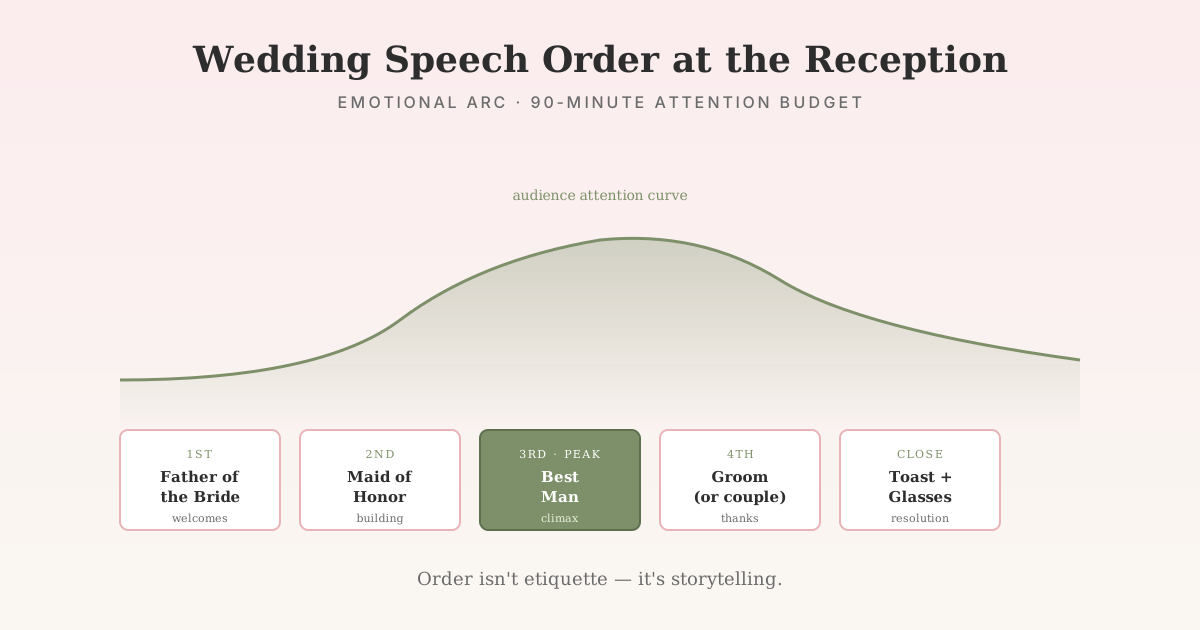
Most articles give you a list of who speaks in what order. That list is downstream of two principles almost nobody names: the emotional arc of the reception and the 90-minute attention budget your guests actually have for speeches. Once you understand those two, the order becomes obvious — and you also know when it's correct to break tradition. Below is the traditional order (US and UK both), the two frameworks that decide order, four situations where you should flex the order, and a deliverable timeline you can hand to the venue coordinator.
Why the standard "order list" usually misses what matters
Open any wedding etiquette article and you'll find the same list: father of the bride → maid of honor → best man → groom → toast. The list isn't wrong. But it's answering the wrong question. The right question isn't who speaks first. It's how do you arrange five speakers so the audience stays attentive across 60-90 minutes of speaking, and the emotional energy in the room peaks where it should?
That's a storytelling question. The traditional order survived because it answers it well — but only for traditional weddings. The moment your family structure varies (divorced parents, bilingual guests, blended households), the canonical list breaks down. You need to know what the list was trying to do, not just what the list says.
The traditional order, and why it works
US traditional order
- Father of the bride (welcome, often the host)
- Maid of honor (bride's side, building intimacy)
- Best man (groom's side, comedic climax)
- Groom — or both partners together (thank-yous)
- Final toast + glasses raised
UK traditional order
- Father of the bride (welcome)
- Groom (thank-yous)
- Best man (closer, comedic climax)
Three speakers total in the UK convention; five (or more) in the US. Both orders end with a peak — the best man — because the audience has invested the most attention to that point and needs a return on the investment. Closing on the highest-energy speech is the single most important rule, and it's the rule almost everyone gets right by accident.
Two frameworks that decide order beyond tradition
Framework 1 — The emotional arc principle
A reception is a three-act story. Act one is welcome (low energy, hospitality). Act two is relationships (rising energy, intimacy). Act three is celebration (peak energy, then resolution through a toast). Speakers should be ordered to ride this arc, not flatten it.
Practical translation:
- Welcome-mode speakers go first. Parent figures, hosts. Their job is to thank guests and set tone, not bring down the house.
- Intimacy-mode speakers go middle. Maid of honor, siblings, close friends. Their job is to share stories that build a sense of who the couple really is to the people who knew them before this day.
- Climax-mode speakers go second-to-last. The best man, the most experienced speaker, the funniest sibling. Their job is to peak the room — laughter, tears, both.
- Resolution-mode speakers go last. The couple themselves, then the toast. Their job is to hand the energy back to the room as gratitude and celebration.
Framework 2 — The 90-minute attention budget
Wedding guests can absorb roughly 60-90 minutes of speeches across the whole reception before attention collapses, food turns cold, and the dance floor never recovers. That budget includes every officiant blessing, every toast, every welcome remark — not just the "named" speeches. Plan against the budget, not against the speech list.
Default per-speaker allocation under this budget:
- Father / parent welcome: 3-5 minutes
- Maid of honor: 4-6 minutes
- Best man: 5-7 minutes (the climax can run long; budget for it)
- Couple / groom thank-you: 3-5 minutes
- Final toast: 1-2 minutes
- Buffer for transitions + applause: ~5 minutes
Total: ~30 minutes if everyone's tight, ~50 if everyone uses their full allowance. The budget pressure you might feel — "we don't have time for more speakers" — is the right signal. Five strong speeches beat eight forgettable ones. (For per-role drafting, the wedding speech generator produces role-appropriate scripts you can tighten to those minute targets.)
Applying the frameworks: a deliverable timeline
Hand this format to your venue coordinator. It's explicit about when, not just who— most speeches go wrong because the order was correct but the timing on the night wasn't.
Reception Speech Timeline — [Couple Names], [Date]
7:45 PM — Guests seated, first course served
8:00 PM — Father of the Bride welcome (5 min target)
8:08 PM — Main course served (no speeches during food clearing)
8:35 PM — Maid of Honor speech (5 min target)
8:42 PM — Best Man speech (7 min target)
8:52 PM — Couple thank-you (5 min target)
8:58 PM — Toast + glasses raised (2 min)
9:00 PM — Cake cut, dance floor opens
The principle: break up the speeches with food and movement. Three speakers in a row will tire the room. Two speakers, a course, then three more keeps attention high.
When to break order — four real scenarios
Scenario 1 — Divorced parents, both speaking
Put them in non-adjacent slots. Father of the bride opens (slot 1); maid of honor speaks (slot 2, buffer); mother of the bride speaks (slot 3); then best man closes. The buffer of an emotionally distinct speaker between the two parents reduces visual contrast for guests who know the family history. Don't put divorced parents back-to-back; it draws attention to the relationship that's ended rather than the one that's starting.
Scenario 2 — Blended families with stepparents
Stepparents who speak go before biological parents, not after. The reverse implies hierarchy. Going first signals welcome from the broader family structure; going after implies that the "real" parent comes last. The exception: a long-term stepparent who effectively raised the bride or groom takes the parent slot, and the absent biological parent gets a brief mention later or in a written program.
Scenario 3 — Bilingual / multicultural weddings
Order by language transition, not just relationship. Open and close in the language of the majority of guests; use the middle slots for the secondary language or for bilingual speakers who can bridge. A monolingual speaker stranded in the middle of an otherwise-bilingual lineup creates dropouts in the attention curve from guests who can't follow.
Scenario 4 — When someone bails on the day
A speaker pulling out at the last minute is more common than couples expect. Don't scramble to find a replacement; promote a planned-shorter speaker to fill the slot, or compress the timeline. The audience doesn't miss a speech they didn't know was coming. They do notice a substitute who's underprepared and stumbling.
Sequencing speeches across the reception (not just back-to-back)
The single biggest order mistake isn't who-speaks-first. It's clustering all five speeches in one 45-minute block. Audience attention starts to drop at minute 25 of speeches, regardless of how good the content is. Split the block:
- Pre-meal: Father of the bride welcome (sets tone, 5 min)
- Between courses: Maid of honor (4-6 min)
- After main course: Best man (5-7 min)
- Pre-cake-cut: Couple thank-you + toast (5-7 min combined)
The food breaks reset attention. Five strong speeches arrive across 90 minutes of dining instead of crammed into 45 minutes of staring at speakers — and the difference between those two formats is what guests remember when they describe the reception two months later.
Frequently asked questions
Should the bride speak?
Yes, if she wants to — the "couple thank-you" slot is for both partners now in most US weddings, not just the groom. The 2025 norm is that whoever has more to say takes the slot, or both partners share it. Skipping a partner speech entirely (only the groom speaks) reads outdated.
Should the maid of honor or the best man go first?
Maid of honor first, best man second-to-last. The best man traditionally closes because his speech is the comedic peak — putting him in the middle wastes the climax and leaves the audience expecting more energy after he's done. Maid of honor speeches are usually warmer and more story-driven, which works as a build-up.
How many speakers is too many?
Six is the practical maximum before the attention budget collapses. If you have seven people who want to speak, ask two to share a slot, or move one to the rehearsal dinner where the audience is smaller and attention is fresher.
Can speeches happen during dinner instead of one block?
Yes — this is the recommended format. Split the speeches across courses so the audience resets attention between each speaker. See the deliverable timeline above for the recommended breakpoints. The all-speeches-in-one-block format is a holdover from formal banquets and rarely the right choice for modern receptions.
Who introduces each speaker?
The MC or DJ. Each speaker introduction should be 15 seconds maximum — name, relationship, and a one-line tee-up. Long MC introductions before each speech is the second-biggest attention killer (after speech overrun). Keep introductions tight.
Drafting and timing the speeches
Once the order is set, each speaker still has to write a speech that fits their slot. For role-specific drafts that respect the time budget, the wedding speech generator produces speeches for father of the bride, maid of honor, best man, mother of the groom, and more — calibrated to the minute targets above. For shorter toasts that close out the speech block, the wedding toast generator produces 30-60 second toast options that resolve the energy of the room cleanly. For a full role-by-role breakdown with copy-ready openings, the best man speech template walks through the five-part structure every speaker slot in this order relies on.
Speakers who need help with the delivery side (not the writing side) should see the wedding speech nerves guide, and for length discipline, the three-minute rule post covers why most speeches feel too long even when they're technically under their allowance. For toast order specifically (which sits inside the speech order), the wedding toast order post covers the closing-glass mechanics.
For external reference on traditional ordering conventions, see The Knot's speech timing guide (US convention) and Bridebook's order guide (UK convention) — both worth a read after you've decided which framework fits your reception.
Originally analyzed by WedGenerator. Last updated: 2026-05-26.