Round vs Long Tables for Wedding Receptions
Long tables fit ~20% more guests but cost more in florals, slower service, and less conversation reach. Guest-count rules and when mixed shapes wins.
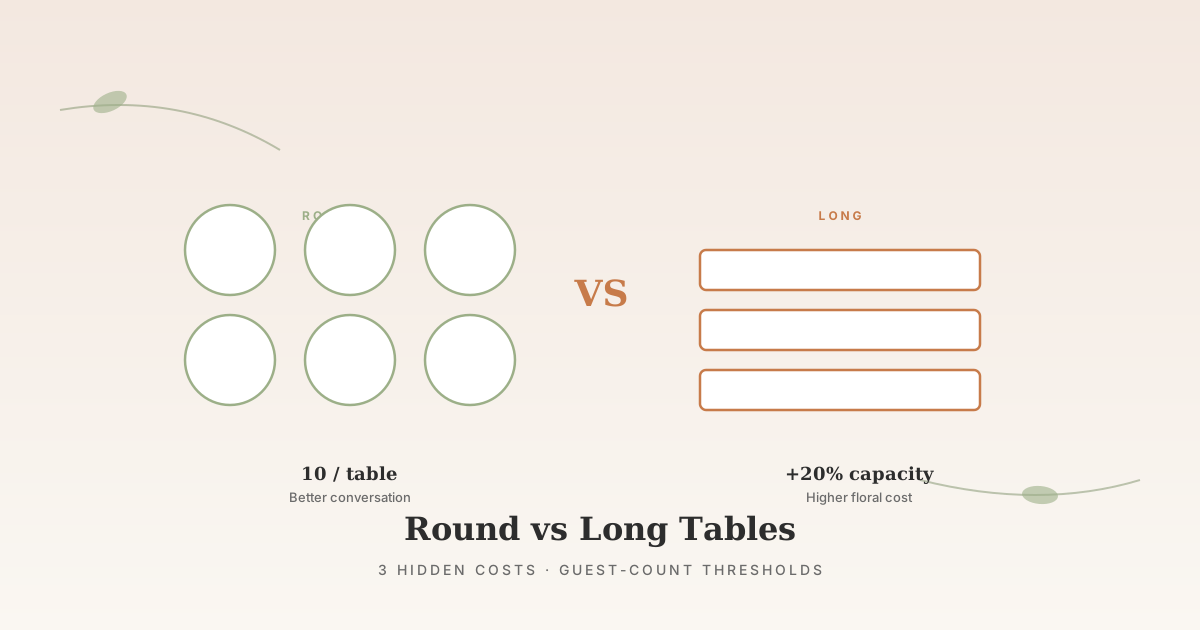
Long rectangular tables fit 15-20% more guests in the same venue footprint. Round tables host meaningfully better conversations and serve faster. The trade-off most couples don’t see until tasting day: choosing tables isn’t aesthetic, it’s a series of downstream consequences for floral budget, service timing, and guest experience. Below: the guest-count threshold rules, the three hidden costs of long tables, the conversation-quality difference (with numbers), and when the right answer is to mix shapes.
Capacity comparison, with numbers
- 72" round. Seats 10 comfortably (8 if budget allows breathing room). Needs ~15 square feet per person including aisle space. 100 guests = 1,500 sq ft of table footprint.
- 8′ rectangular. Seats 8 (10 if elbow-to-elbow). End-to-end placement reduces dead space. 100 guests = roughly 1,200 sq ft. 20% efficiency gain.
- King’s table (4 or 5 8′ rectangulars end-to-end). Seats 30-40 along a single run. Best capacity option for venues with awkward narrow footprints.
Guest-count threshold rules
- Under 40 guests. A single long king’s table is the right call. Single conversation thread, intimate, photographs as one cohesive family-style scene. Round tables here feel diffuse.
- 40-90 guests. Either works. Decide on the room shape — long and narrow venues favour long tables (the room shape echoes the table shape); square or wide-open venues favour round.
- 90-150 guests. Round tables are usually the better answer. Multiple long tables in this range start to feel like a banquet hall. Round preserves the small-group feeling.
- 150+ guests. Round, or mixed. The conversation density drops sharply at this scale and round preserves the “your table is the unit” feeling that keeps engagement high.
The 3 hidden costs of long tables
Cost 1: Floral spend
Round tables typically need one centrepiece each. Long tables usually want a continuous floral runner (or 2-3 staggered centrepieces per table). For a 100-guest wedding: 10 round centrepieces × $150 = $1,500 floral. 4 long tables × 8 ft of floral runner × $80/ft = $2,560. Long tables run ~70% higher on florals at the same guest count.
Cost 2: Service speed
Round tables can be served all-at-once by one waiter per table — typically 8-10 plates per round, 4-6 minutes from first to last delivery. Long tables of the same capacity need more service stations (waiters can’t reach across a 36" table comfortably). 100 guests at long tables runs roughly 30-40% slower from kitchen to last plate. The room notices.
Cost 3: Conversation reach
At a round 10-top, a guest can comfortably converse with approximately 4-5 of the other 9 (their immediate neighbours + the 2-3 across). At a long table of 10, they can comfortably converse with 2-4 (the 1-2 to each side + the 2 directly opposite). Long tables reduce conversational range by ~30-40%. This is the trade-off most couples don’t see until the reception is happening.
When mixed shapes is the right answer
Two specific cases.
- Long king’s table for bridal party + family, rounds for everyone else. The bridal party photographs together at the long table (great for the album), and the rest of the guests retain the round-table conversation experience. Most-recommended mixed format for 80-150 guest weddings.
- Sweetheart table (just the couple) + rounds. Separates the couple from family dynamics, keeps the head table moment, and the guests get the better conversation shape. Best when divorced parents are present (see seating chart drama rules for the why).
Pick by venue, not by Pinterest
Pinterest favours long tables because they photograph dramatic from a single high angle. That look isn’t false; the long tables in those photos really do photograph well. But they were chosen for a venue that suits them — usually a barn, a vineyard, or a loft with long sight lines. Your venue’s actual proportions matter more than the trend. Walk the room with your planner before committing.
Visualise the layout before signing
Drag-and-drop the floor plan with both shapes in the seating chart maker before locking the rental order. Run a comparison of the same guest count in both configurations — the layout tool shows which one breathes and which one feels tight in your specific venue dimensions.
FAQ
Do round or long tables fit more guests?
Long rectangular tables fit about 15-20% more guests in the same venue footprint — an 8’ rectangular seats 8-10 in roughly 1,200 sq ft per 100 guests, versus 1,500 sq ft for 72" rounds.
How much space should be between wedding reception tables?
Budget about 15 square feet per person including aisle space for round tables — for 100 guests that’s roughly 1,500 sq ft of table footprint. Long tables run about 20% more efficient on the same guest count.
Should I use round or long tables for my wedding?
Under 40 guests: a single long king’s table. 40-90: either works, let the room shape decide. 90+: round tables usually preserve the conversation quality better as the guest count climbs.
Where the rules break
Two cases. First, family-style serving (shared platters in the middle of each table — common in Italian, Greek, Persian weddings). The shared-dish format flips the conversation calculation — long tables work because everyone is busy passing food, the “reach” problem disappears. Long tables become the natural choice at any guest count. Second, tea-house and Chinese restaurant venues where the round-table format is the venue’s native shape. Don’t try to long-table a venue built around lazy susans.