Wedding Toast Order: Who Speaks First (and Why It Matters More Than You Think)
Toast order is an energy-management question, not an etiquette one. The traditional curve (warm → laugh → emotional close), three modern variants, and the closer principle.
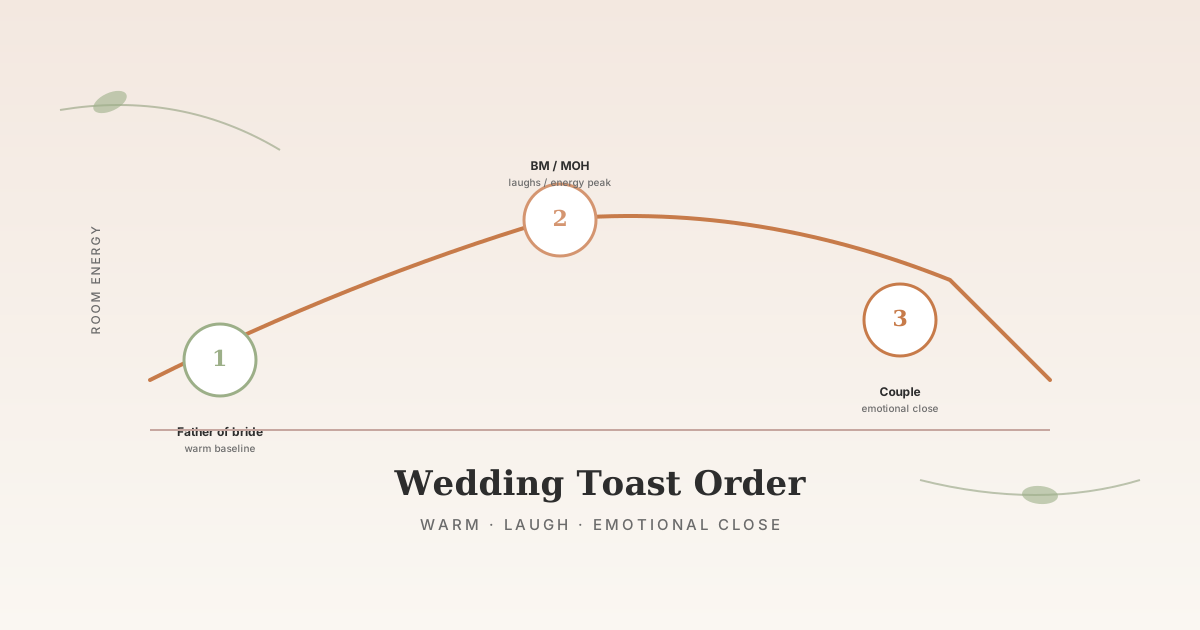
Wedding toast order looks like an etiquette question. It is actually an energy-management question — each speech does a specific thing to the room, and the sequence determines whether the reception peaks at the right moment. The traditional order (father of the bride → best man / MOH → couple) holds for a specific structural reason most guides don’t name. Below: the energy curve each role produces, three modern variants for non-traditional families, and the “closer principle” that decides the sequence when the standard order doesn’t apply.
The traditional order, and what it’s doing
- 1. Father of the bride. Opens the speeches. Sets the warmth baseline — earnest, paternal, family-of-origin. The room settles. This is the “welcome to the reception” speech even if the words don’t say it.
- 2. Best man / maid of honor. Brings the laughs. The room is warm, dinner is mostly done, guests are ready for energy. The peer-perspective humour lands hardest in this slot because the family-formal opening has set the contrast. See the best man speech template for the structure that fills this slot.
- 3. Groom / couple. Closes with gratitude. Thank-yous, the personal note about the partner, the kick-off into the first dance. The couple’s words land hardest when the room has already been warmed by both formal and humour notes.
That’s the energy curve: warm → laugh → emotional close. Each slot is structurally necessary for the next one to land. Move them around carelessly and the curve breaks.
Why the order matters more than people think
Specific failure modes from the wrong order:
- Best man first, dad second. The humour peaks first; dad’s sincere speech now reads as anticlimactic. Father-of-the-bride speeches typically underperform when they follow a strong BM/MOH.
- Couple first, BM/MOH last. The couple’s emotional close is now the opener; the BM/MOH’s comedy has to bring the room down from an emotional peak. Comedy doesn’t recover from earnestness in the same way earnestness recovers from comedy.
- Four speeches without the curve. More than three speeches without conscious sequencing — the room flattens. Each speech absorbs a chunk of attention budget and the fourth slot has the least.
Modern variant 1 — Same-sex couple
Sequence: one parent of partner 1 → one parent of partner 2 → BM/MOH from each side (or two-from-one-side if asymmetric bridal party) → couple speaks together (or both speak briefly in sequence). The energy curve is the same; the role labels adapt. Avoid splitting it as “family of partner 1 first, family of partner 2 second” — the asymmetry calls attention to itself. Alternate.
Modern variant 2 — Single parent giving away
Sequence: solo parent (mother or father, whichever is the speaker) → MOH/BM → couple. Don’t add a second parent speech unless that parent is genuinely uncomfortable speaking; a single solo-parent speech that’s allowed to land carries more emotional weight than two split speeches.
Modern variant 3 — Second wedding / blended family
Sequence: skip the parent speech entirely OR have a couple’s child speak briefly → BM/MOH (often a sibling or close friend, not always a peer) → couple closing. Skipping the parent speech in a second wedding is becoming standard; forcing it can surface comparisons to a previous marriage. A child’s 60-second speech in that slot lands warmly without comparison risk.
The closer principle
Whoever the couple wants to close on is the actual most important decision. The closing speech is the one guests remember most — and it sets the emotional tone of the immediate post-speech moment (typically the first dance). Pick the closer first, then build the order backwards from there.
- Couple closing (default): Gratitude + intimate note + first dance kick-off. Lands as a transition into the dancing.
- Best man / MOH closing: Works if the BM/MOH is genuinely the strongest speaker and has a moving (not just funny) speech. Risky if the speech is mostly comedic — laughter is a weak transition to first dance.
- Parent closing: Rare but powerful in specific cases — a parent toasting a deceased grandparent, a parent who couldn’t be present at the engagement, an immigrant parent thanking the room.
Timing the speeches within the reception
Three-quarters of the way through dinner is the sweet spot: guests are seated, fed, and warm, but the dinner courses aren’t finished yet (servers still have a reason to be moving and clearing). Past dinner-end, the room cools 15-20% per 10-minute delay. Don’t schedule speeches after dessert — the dance floor calls and you’ll lose the room mid-toast. For length recommendations per role, see wedding speech length: the 3-minute rule.
Building each speech / toast
For full draft starts by role, use the wedding speech generator. For a short structured toast specifically (90 seconds, one anecdote, one wish), use the wedding toast generator — pairs with the 30-minute writing process in write a wedding toast in 30 minutes.
Where this advice breaks
Two contexts. Traditional Indian, Chinese, and many Mediterranean weddings build speeches into a different ceremonial timeline (sangeet, tea ceremony, family-elder blessings) rather than a single reception block. The energy-curve model still applies but the slots and timing are different. Defer to family elders / wedding coordinators on the cultural-specific sequencing. Second: weddings with a long pre-recorded video element (memorial slideshow, family video) — treat the video as one of the “speech” slots in the energy curve and order it accordingly. A memorial video typically goes between the parent speech and the BM/MOH speech, never as the last item.