Why Most Wedding Vow Templates Feel Hollow (and How to Fix Yours)
Three failure modes that flatten templated vows — universal promises, recycled metaphors, performative imagery — plus four specific prompts that produce vows nobody else could have written.
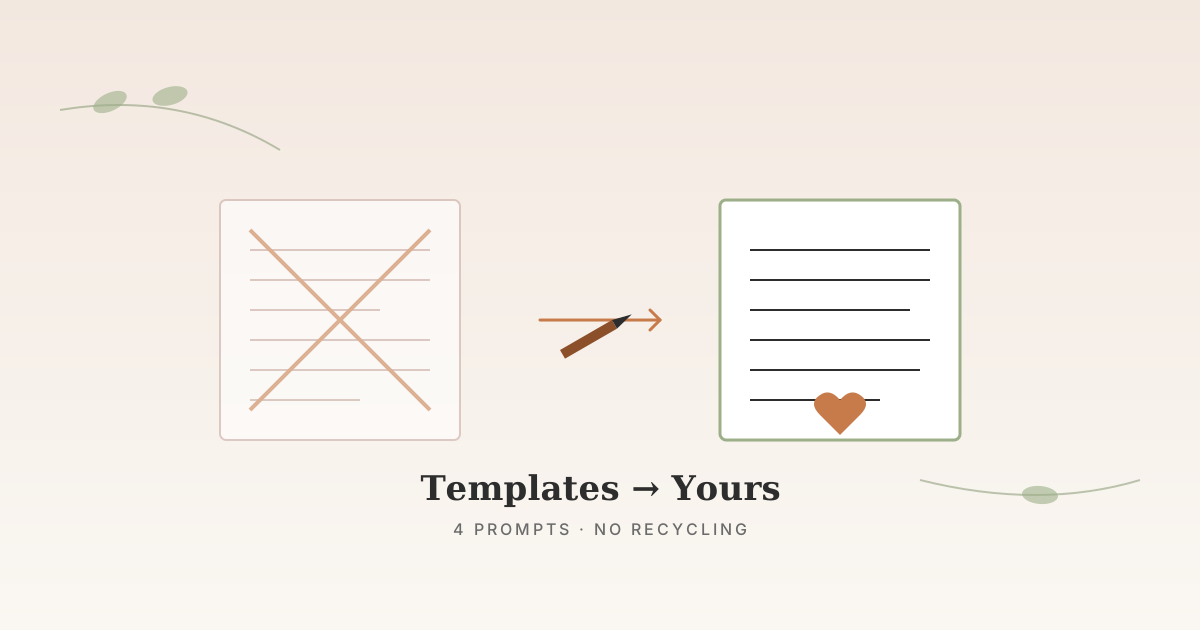
Most wedding vow templates produce hollow vows because they ask abstract questions (“what do you love about them?”) that prompt abstract answers (“their kindness”) that fit any couple. The fix is not more templates — it’s four specific questions that surface the details no template asks for. Below, the three failure modes that make templated vows feel interchangeable, the four prompts that produce non-recyclable vows, and before-and-after examples showing the shift.
Why templates flatten
Wedding vow templates are written to be reusable, and that’s exactly the problem. A template that any couple can fill in produces vows any couple could have written. The result reads as performed rather than meant — the audience can tell within the first two sentences, and the partner standing across from the speaker usually can too.
The three failure modes show up across nearly every templated vow.
Failure 1: Universal promises
“I promise to love you, to support you, to be your partner in everything.” Every wedding has these sentences. They’re not wrong; they’re inert. A universal promise commits to nothing testable. The fix: name a specific situation in which the promise will be tested.
- Before:“I promise to be there for you in hard times.”
- After:“I promise that when your mum’s treatment gets worse — and we both know it will — I will drive you home from the hospital and not ask you to talk about it that night.”
Failure 2: Recycled metaphors
“You are my anchor / my home / my best friend / my person.” These were specific images once. They’re now wedding-vow background noise. The fix: replace the borrowed metaphor with the literal observation that originally produced it.
- Before:“You are my home.”
- After:“The first night in our flat I couldn’t sleep, and I realised it was because I had been sleeping at your place for so long that the silence in mine had become unfamiliar.”
Failure 3: Performative imagery
“Through every sunrise and every storm…” Imagery that is performed for the audience rather than the person you are addressing. Test: would you say this sentence to your partner in private? If no, cut. Real vows sound like real speech — the audience tolerates plainness from a vow far better than from a speech, because they read it as honest.
The 4 prompts that produce non-recyclable vows
Replace “what do you love about them” with these four. Write three minutes per prompt. Don’t edit while writing.
- What is one small thing they do almost every day that you don’t even register anymore — but that you’d miss immediately if it stopped? This question reaches for the texture of the relationship rather than its peaks. Examples: the way they always pour your coffee first, how they ask “is your phone charged?” before you leave, the songs they hum in the kitchen.
- When did you realise — concretely, on what day, in what room — that this was the person? “I always knew” doesn’t produce a vow. A specific Tuesday produces a vow. The opening line of a great vow is almost always a sentence that places the listener in a particular moment.
- What is one thing they have changed about you that you didn’t ask to change — that you’re now glad for? This surfaces the part of the relationship that involves actual influence, not just attraction. Vows that include this question feel earned in a way that pure praise doesn’t.
- What is one specific thing you are committing to do, that you have not always done well, that they specifically need? A real promise. Different from the universal promise above — this names the thing you struggle with and the way you will show up despite it. The audience hears this as honest because it costs the speaker something.
Structure: open small, close small
Most great vows open with a specific moment, sit with one observation, name two or three promises (each specific), and close with one sentence directed at the partner alone. The bookend technique — open and close with sentences spoken to the partner rather than performed to the audience — is what separates vows that read as wedding-speech from vows that read as actual vows.
Length: 200-350 words spoken (90 seconds to 2 minutes). Longer rarely helps. The audience is rooting for both of you, not evaluating literary quality.
Edit aloud, with your partner not in the room
Read the draft out loud, alone. Any sentence that makes you cringe is a sentence that will make the audience cringe twice as hard. Cut. Any sentence that you would never actually say to your partner in a normal conversation: cut. What remains is the vow.
Use a generator for scaffold, not for content
The right way to use the wedding vow generator is for structure — generate a scaffold in one of three tones (sentimental, balanced, lighthearted), then replace every templated sentence with answers from the four prompts above. Use the generator for the bones; never ship the prose it produces unchanged. For the complementary how-to, how to write wedding vows walks through the from-scratch path.
Where this advice breaks
Religious and traditional vows — Catholic, Orthodox, Hindu, Islamic, Quaker — are themselves the vow; modifying them defeats the point. If your ceremony follows a liturgical script, the personal piece is read at the rehearsal dinner or during the reception, not at the altar. Treat those settings as the audience this guide describes. Similarly, secular but traditional “I, [name], take you, [name]” forms are not vows in this sense — they are oaths, and the work of making them personal happens in the vows of the heart spoken immediately after.