Wedding Invitation Wording When Parents Are Divorced (9 Scenarios)
The 3-question framework + wording for 9 real scenarios — divorced parents, remarried, estranged, hybrid families, and self-hosting couples.
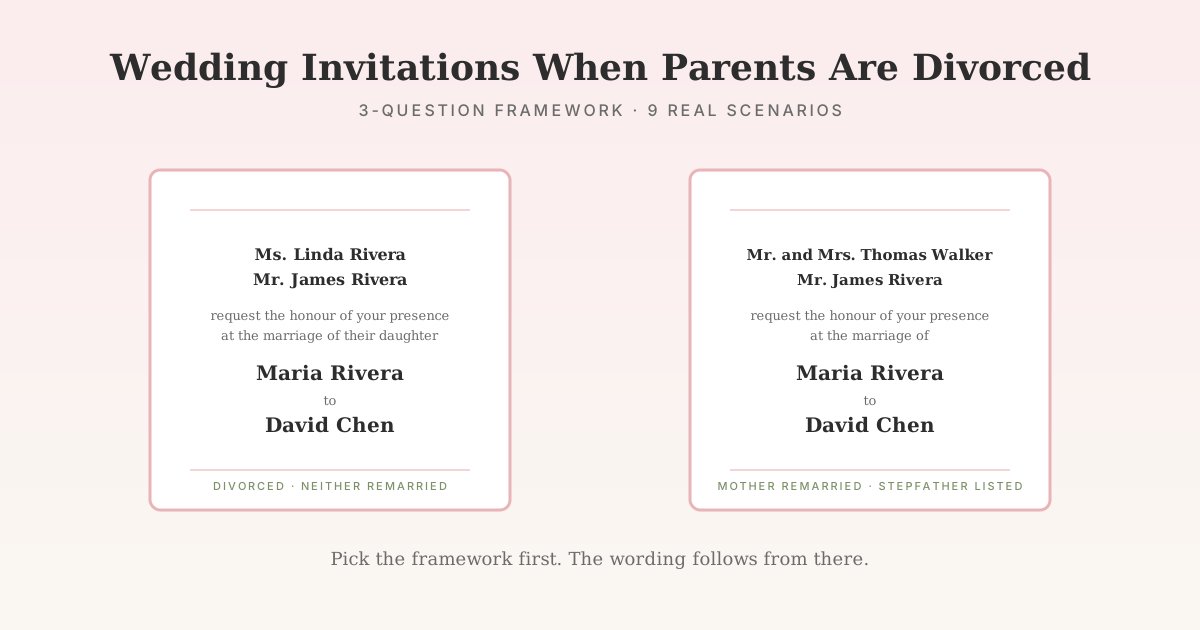
Most articles on divorced-parents wedding invitation wording give you templates without telling you which template fits. That's why couples end up with three contradictory drafts and a fight with their mother. The templates aren't wrong. They're downstream. Before you pick wording, you need to answer three questions about who you're actually inviting people on behalf of, who would be hurt by being left off, and what social work the invitation is supposed to do. Get those three answers and the wording becomes obvious.
Why the standard templates fail half the time
Walk into any wedding-etiquette article and you'll find the same set of rules: divorced parents go on separate lines, no "and" between their names (because "and" signifies marriage), mother first unless father is the sole financial host. Those rules are accurate. They're also useless when your real question is whether your mom's new husband of twelve years gets a line at all — or whether your absent father should appear when he hasn't paid for the wedding, called in two years, or asked how the planning is going.
Standard templates assume a clean divorce, two cooperating ex-spouses, equal financial contribution, and stepparents who are clearly either "in" or "out." That family configuration exists, but it's a minority of real cases — most couples who come to the save-the-date generator with divorced-parent wording questions are dealing with at least one variable the templates don't handle: a long-term stepparent of debated prominence, an absent or estranged biological parent, or a couple paying for the wedding themselves while parents still want to be named. Those edge cases need judgment calls the templates skip.
The 3 questions to answer before you write anything
1. Who is actually hosting (funding) the wedding?
"Hosting" in traditional invitation etiquette means "paying for." If your parents are paying, they host. If you and your partner are paying, you host. If contribution is split, multiple people host. The host line determines the top of the invitation — full stop. Skip ahead to scenario 6 if neither parent is contributing financially; most templates assume parents host by default and that assumption breaks for modern couples.
A non-funding parent who insists on being on the invitation as a host is asking you to lie about who paid. You don't have to do that. You can still name them prominently lower in the invitation ("daughter of...") without putting them on the host line.
2. Whose feelings get hurt if they're not named?
This is the real question most couples are dancing around. Make the list. For each parent and stepparent, write down:Will they notice if they're not on this paper? How will they respond? A stepfather of fifteen years who walked you down the kindergarten hallway and now isn't on the invitation will notice. A biological father who hasn't been in your life since middle school may not — and even if he does, that's a relationship-level problem the invitation can't solve.
Etiquette rules tell you what's "correct." Whose-feelings-get-hurt tells you what you actually want to live with. Reconcile them in that order — etiquette never overrules a real relationship.
3. What social work should the invitation do?
An invitation announces three things to your guest list: the event details, the family structure as you want it publicly understood, and the level of formality of the wedding. The second one matters more than couples realize. Whoever you list, your guests will assume is "in" on the day, will be in family photos, and will be addressed from the podium. Pick names you're comfortable introducing in those contexts. Stepparents you list will be expected to give toasts. Biological parents you omit may not be seated at the head table.
Scenario 1 — Divorced, neither remarried
Both parents on separate lines, no "and" between them. Mother first if both are contributing; father first if only father is. Use "Ms." for mother to avoid any confusion about marital status ("Mrs." can imply still-married, which is wrong here).
Ms. Linda Rivera
Mr. James Rivera
request the honour of your presence at the marriage of their daughter
Maria Elizabeth Rivera
to
David Chen
Saturday, the twelfth of September two thousand twenty-seven
Scenario 2 — Divorced, one remarried (stepparent involved)
If the stepparent has been in your life for years and you'd want them on the day, list the remarried parent with their current spouse (use the "Mr. and Mrs." format), then the other parent on the next line.
Mr. and Mrs. Thomas Walker
Mr. James Rivera
request the honour of your presence at the marriage of
Maria Elizabeth Rivera
to
David Chen
The remarried-parent line comes first if they're hosting more financially, or if you're closer to them emotionally. Yes, this is a judgment call. Etiquette can't rank emotions for you.
Scenario 3 — Divorced, both remarried
Two "Mr. and Mrs." lines, one per household. Mother's household first (with stepfather) unless father's household is the primary financial host.
Mr. and Mrs. Thomas Walker
Mr. and Mrs. James Rivera
request the honour of your presence at the marriage of
Maria Elizabeth Rivera
to
David Chen
If stepparents are technically married to your biological parents but barely present in your life, you have permission to omit them by name and instead list the biological parents individually ("Ms. Linda Walker" / "Mr. James Rivera"). This is rare and slightly unconventional, but defensible when the stepparents themselves prefer not to be named.
Scenario 4 — One parent has passed away
Name the surviving parent on the host line, but acknowledge the deceased parent in the body of the invitation as "daughter of [surviving parent] and the late [deceased parent]."
Ms. Linda Rivera
requests the honour of your presence at the marriage of her daughter
Maria Elizabeth Rivera
daughter also of the late Mr. James Rivera
to
David Chen
The phrase "daughter also of" (rather than "and the late") reads warmer and avoids the clinical "late" appearing alongside the celebratory host line. Both forms are accepted; pick the register that fits your family.
Scenario 5 — Estranged from one parent
Don't list a parent you have no relationship with. This is the scenario standard articles dodge. The correct answer is: name only the parent who is actually in your life. Etiquette does not require you to perform a relationship that doesn't exist.
Ms. Linda Rivera
requests the honour of your presence at the marriage of her daughter
Maria Elizabeth Rivera
to
David Chen
Phrase it as "her daughter" (singular possessive) rather than "their daughter," which would imply co-hosting. This wording quietly signals the family configuration without making it a confrontation. If the estranged parent asks why they weren't named, you have a perfectly defensible answer: you weren't hosting. If they push further, that's a separate conversation, not an invitation-design problem. The family-pressure scripts post covers how to handle that follow-up.
Scenario 6 — Couple hosting themselves (no parents on invitation)
The fastest-growing category in modern wedding etiquette. Couples now pay for their own weddings in much higher proportion than a generation ago — and when you're paying for it, you host. Skip the parental host line entirely and put your own names at the top.
Maria Elizabeth Rivera
and
David Chen
request the honour of your presence at their marriage
Some couples add a courtesy line acknowledging parents further down ("together with their families"). This sidesteps the divorce question entirely — no parent is named individually, no comparison or hierarchy. Useful when family dynamics are too complex to encode in two lines.
Scenario 7 — Hybrid (parents contribute but couple hosts)
The couple is the host, but parents contributed materially. Recognize the contribution lower in the invitation:
Maria Elizabeth Rivera
and
David Chen
together with their parents
Ms. Linda Rivera, Mr. James Rivera
and Mr. and Mrs. Daniel Chen
request the honour of your presence at their marriage
This format is the cleanest answer when you want to honor contribution without re-litigating the host line. The couple is plainly named first; parents are acknowledged but not described as hosting.
Scenario 8 — Stepparent more involved than the biological parent
Name the stepparent in the line where the biological parent would conventionally go. This is technically non-traditional, but the traditional convention is wrong for your family. Make sure the biological parent has been consulted — they'll see this invitation and have feelings about it.
Ms. Linda Rivera and Mr. Thomas Walker
request the honour of your presence at the marriage of
Maria Elizabeth Rivera
(daughter of Ms. Linda Rivera)
to David Chen
The parenthetical "daughter of" clarifies the biological relationship without demoting the stepparent's presence. Etiquette purists will object; your relationships will be served.
The mechanics: "and" vs comma vs line break
- "And" between two names signals marriage. Use only between currently-married couples (a parent + their current spouse), never between divorced exes.
- Line break between two names signals separate hosting. Use to list divorced exes individually, or two separate parental households.
- Comma between two names signals a list, weakest of the three. Use sparingly — for example, when listing both sets of parents on the same line in a hybrid host invitation.
- "Together with" is the modern compromise — acknowledges family without implying joint hosting. Use in self-hosted couple invitations.
When you can't decide, default to this
Use the scenario 6 self-hosted format. Name the couple first; add "together with their families" one line down. No individual parent is named on the host line, no comparison or hierarchy is encoded, and no party can feel singled out as excluded. This is the diplomatic default that works in 90% of mixed-family situations and avoids the worst-case "why isn't my name on this" conversation.
The traditional purists will say it's non-traditional. They're right. But traditional wedding etiquette was built for nuclear families and single-host hierarchies that simply don't describe the average 2026 wedding. The self-hosted couple invitation is the modern default for a reason.
Limits of any wording solution
Some family dynamics no invitation can solve. If your parents will fight over whose name appears in what order regardless of what you write, the invitation is not the right venue to fix that. Pick a defensible format, send it, and have the harder conversation separately — ideally before the invitation goes out, not after. A draft sent to one parent for approval before the other sees it usually doesn't survive that information asymmetry.
For situations where the invitation choice triggers a bigger family conversation, the save-the-date routing guide covers when to surface family decisions earlier in the timeline. And once the invitation is out, the save-the-date templates post keeps the rest of the wedding communication tonally consistent with whatever wording you ended up with.
Frequently asked questions
Should my mother's new husband be on the invitation?
Only if (a) he's been your stepparent long enough to be a real part of your life, and (b) he'll be a visible figure on the wedding day. If he'll give a toast, sit at the family table, or appear in family photos, list him. If he'll attend as a guest like any other, don't.
What if my parents are divorced but co-parent well?
Scenario 1 still applies — separate lines, no "and." The "and" isn't a statement about how well they get along; it's a marital-status signal. Co-parenting well is wonderful; it doesn't bring back the marriage on paper.
Can I list my father if he hasn't contributed financially?
Yes — but lower in the invitation, not on the host line. Move to a self-hosted format (scenario 6 or 7) and list him in the "daughter of" line. This honors the relationship without misrepresenting the financial hosting.
Do save-the-dates have the same rules?
No. Save-the-dates are short and informal by design; most couples skip parent names entirely on the save-the-date and only put names on the formal invitation. This sidesteps the divorced-parents question for the first round of communication.
Should I show both parents the draft before printing?
Show both — at the same time. Sending one a draft before the other almost guarantees the second parent feels like a consulted afterthought. If you can't risk a joint review, don't do a review at all; send the printed invitation cold and absorb whatever reaction comes.
Generate the rest of your wedding communication
Once you've picked the invitation wording, the rest of your communication should match its register. The save-the-date generator produces a save-the-date card in the same tonal family, and the wedding planning timeline flags when each piece of communication needs to go out so your invitation arrives at the right RSVP window.
For external etiquette references on the mechanics of formal invitation wording, see Ann's Bridal Bargains' template guide and The Knot's sticky-situation guide — both worth consulting after you've answered the three framework questions first.