Can't Attend a Wedding? A 5-Path Decision Framework Before You Reply
Five distinct paths when you can't attend: full attend (restructured), ceremony only, virtual, decline with gift, decline outright. Plus the 30-second filter that picks one.
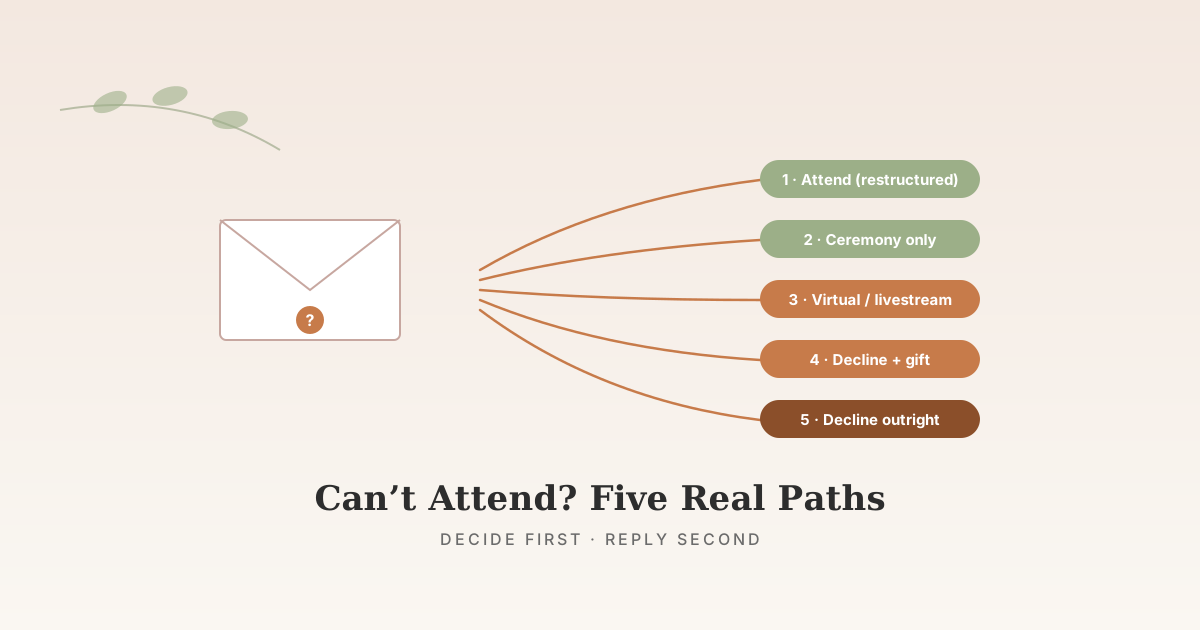
Before you decide what to say when you can’t attend a wedding, decide which version of “not attending” you actually mean. There are five distinct paths, not two — and the typical etiquette post jumps straight to “here’s how to send your regrets” without helping you see that ceremony-only or virtual attendance are usually still on the table. The five paths below, in roughly increasing degree of absence, and the signals that point to each.
Path 1 — Attend in full (cost-restructured)
Default consideration. The instinct to decline often comes from a budget shock — a $400 hotel night, a $250 flight, a $150 outfit. Before you write the regrets card, see whether the actual cost is the venue stay vs an Airbnb 20 minutes out ($90 vs $400), Tuesday vs Saturday flight ($90 vs $310), a rented suit ($80) vs new. For weddings within 4 hours of you and a hotel night under $150, the all-in for a single guest is typically $300-450 — within range for most close-friend invitations.
Signal:You’re immediate family or in the couple’s top-20 closest people, AND the cost is within 25% of your monthly take-home after rent.
Path 2 — Ceremony only
The most under-used path. If the ceremony is local-to-you and the reception is destination, attending the ceremony — even without the reception — counts as “there” in the only way that matters socially. Couples almost universally prefer this to a full no. The cost is one travel slot and one outfit, not three nights and a flight.
Signal:Multi-day wedding weekend, ceremony and reception in different locations, and you can’t commit to the full weekend.
Path 3 — Virtual / livestream attendance
Post-2020, ~30% of weddings include a livestream link in the invitation or wedding website. If yours does, asking to be included by Zoom or stream is non-controversial. If it doesn’t, you can ask: “I can’t make the flight — any chance a phone can be propped up at the ceremony for an hour?” The hit rate is high if you’re close family. Lower if you’re a college friend.
Signal:You’re family but logistically blocked (newborn, medical, immigration, active military). Skip Path 3 if the wedding is small — proposing a livestream for a 30-person micro wedding feels clumsy.
Path 4 — Decline with gift + presence
The standard polite decline. RSVP no, send a gift in the $50-150 range (registry items photograph as ungrudging), and plan one in-person catch-up within the 6 weeks after the honeymoon. The catch-up is the part most people skip and is the part that actually maintains the relationship — a card plus a gift without a follow-up dinner reads as a transactional “sorry.”
Signal: Most invitations from friend-of-a-friend, coworker, distant relative. Default to this when in doubt.
Path 5 — Decline outright
No gift, no follow-up, no presence. The right path when the invitation was a B-list courtesy, when the relationship is already distant, or when you have a genuine reason to step back from the couple (active fall-out, a partner whose history with them is fraught). The honesty here is doing them the favour of not faking enthusiasm. A short, warm message — no excuse — is the form.
Signal:You wouldn’t have been hurt to be off the list in the first place.
Which path are you on? The 30-second filter
- How would you feel if you found out a week later that they got married without inviting you? Devastated → Path 1 or 2. Mildly surprised → Path 4. Fine → Path 5.
- Is the blocker money, time, or relationship? Money → restructure the cost before declining (Path 1). Time → ceremony only (Path 2) or virtual (Path 3). Relationship → Path 5 with no guilt.
- Would the couple genuinely notice if you weren’t there? If the answer is “probably not” — that’s your honest read, not a self-deprecating joke — Path 4 or 5 is fine. Don’t blow $600 to avoid feeling rude.
Drafting the message
Once the path is chosen, the message is short. Three rules: no over-explaining (one sentence of reason is enough, zero is fine), no fake commitment to “making the next one,” and lead with the warm bit, not the apology. The decline generator gives three side-by-side variants (safe / honest / diplomatic) and a believability score that flags when an excuse reads as invented.
For specific scenarios — destination wedding cost, coworker invitation, a wedding you don’t want to attend — see the full decline-etiquette guide and the destination-cost guide.
Where this framework breaks
Two scenarios. First: weddings where you’re in the bridal party — the framework doesn’t apply, you have a different decision (full attend, or step down formally; see our step-down guide). Second: cultural contexts where a wedding invitation is a whole-family obligation (typical in South Asian and many Eastern European traditions). In those, “Path 4 with no guilt” isn’t available — declining has more weight than the framework here suggests. Defer to family elders before applying US-default etiquette.