Winter Wedding Color Palettes That Don't Look Like Christmas
Five winter wedding palettes that read winter, not holiday — plus the Christmas-creep test and the December 20-25 exception when the rules flip.
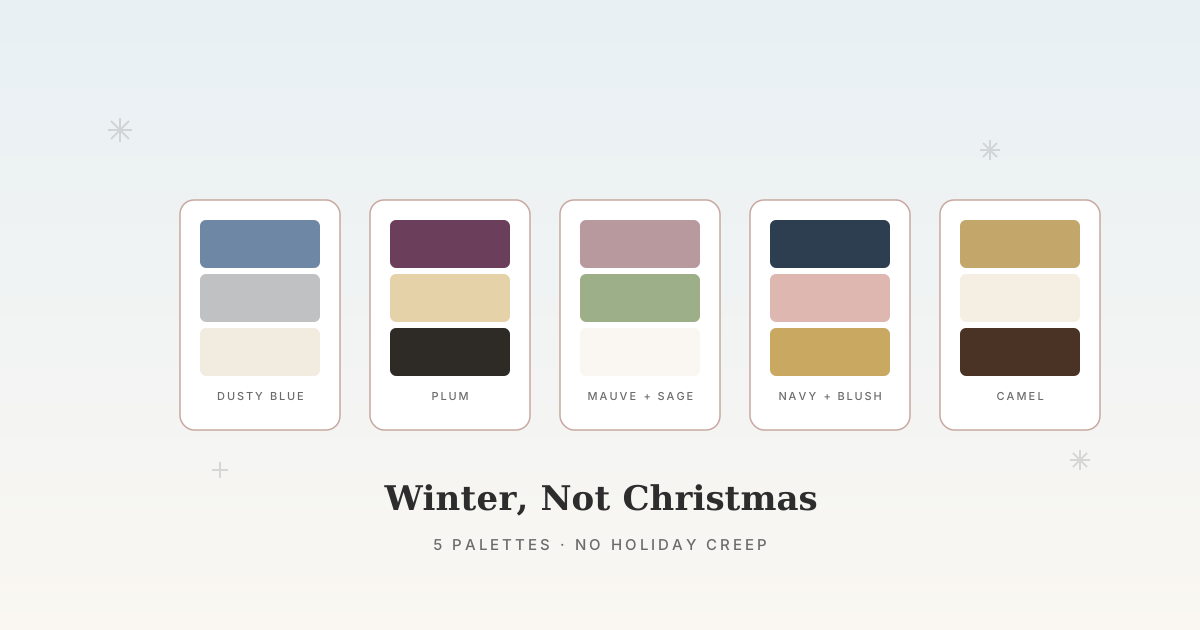
The biggest mistake winter wedding couples make isn’t a bad palette — it’s a palette that accidentally reads as “Christmas wedding.” Forest green, burgundy, gold accents, evergreen sprigs in the centrepieces — individually fine, together a holiday party. The bigger constraint winter weddings face is light: a 5pm December ceremony has 70% less ambient light than a 5pm June ceremony, and palettes that photograph well in summer light wash out under venue tungsten. Below: five winter palettes that avoid the Christmas trap, the winter-light test, and the venue setting where the rules flip.
The Christmas-creep test
Before locking any winter palette, run the three-element test:
- Red intensity.Is your “burgundy” closer to wine (#722F37) or closer to true red (#A60B0B)? Wine reads as winter. True red reads as Christmas. Cut anything past Pantone 19-1664.
- Green intensity. Is your “forest green” muted (#5C7A53) or bright pine (#1B5C2E)? Muted reads as winter. Bright pine reads as holiday wreath. Stay under 50% saturation.
- Gold dose.Gold is the most powerful Christmas signal — pair it with anything green and you’ve made a Christmas palette. If you want gold, pair it with deep blues, mauves, or champagne — not green.
If you fail two of three, your palette is going to read holiday. Adjust.
5 winter palettes that read winter, not Christmas
Palette 1 — Dusty blue + silver + cream
Anchor #6D87A4 (dusty blue) + #BFC1C2 (warm silver) + #F1EBE0 (cream). Reads as “winter sky at dusk.” The cooler end of the spectrum, with no holiday signals. Photographs beautifully under venue LED. Best for January / February weddings where outdoor or window light is grey.
Palette 2 — Plum + champagne + soft black
#6B3E5C (plum) + #E5D2A8 (champagne) + #2E2A26 (soft black). Romantic and slightly moody. The champagne softens the plum so it doesn’t read goth; the soft black grounds it. Best for evening receptions in industrial / loft venues.
Palette 3 — Mauve + sage + winter white
#B89A9E (mauve) + #9CAF88 (sage) + #FAF7F2 (winter white). The unexpected variant. Sage in winter reads “evergreen-adjacent without being a wreath.” Best for greenhouses, conservatories, and venues with abundant natural light. Avoid for windowless ballrooms — without ambient light the mauve flattens.
Palette 4 — Navy + blush + brushed gold
#2C3E50 (navy) + #DDB7B0 (blush) + #C9A961 (brushed gold). Gold here pairs with the blush instead of green, so it reads as winter elegance rather than holiday glitter. Photographs extremely well under candlelight. Best for evening ceremonies and church-to-reception flows.
Palette 5 — Camel + ivory + chocolate
#C2A66A (camel) + #F5EFE3 (ivory) + #4A3324 (chocolate). The warm-neutral option. Reads as “cosy fireside” without a single holiday note. Pair with brass instead of gold for metallics. Best for barn / lodge / wine-cellar venues. Works as a cool-weather variant of fall earth-tone palettes — see terracotta + sage wedding palette for the autumn cousin.
The winter-light test
Winter venues run lighter on natural light and heavier on artificial light. Two specific tests:
- 4:30pm window test (if outdoor or window-heavy venue). Lay your palette swatches under the venue’s windows at 4:30pm on a comparable winter day. December sun at 4:30pm in most US latitudes is golden-hour-fading-to-grey — palettes with cool undertones (palettes 1, 3) photograph beautifully here; warm-anchor palettes (4, 5) compete with the light.
- Venue tungsten test. Move the same swatches inside under venue tungsten / incandescent / warm-LED. Warm palettes glow; cool palettes (1, 3) shift cooler-still and may flatten. If your venue has warm uplights, lean palettes 2, 4, or 5. If cool, lean palettes 1 and 3.
The full 7-step test sequence is in how to test a wedding palette — same logic, longer treatment.
When the rules flip — December 20-25 weddings
If your wedding falls inside Christmas week (Dec 20-25), the Christmas-creep rule reverses. Guests are already in holiday mode, the venue is probably already decorated, and resisting the holiday palette reads as fighting the day. Lean into it: velvet ruby, deep emerald, warm gold, evergreen all read as celebratory rather than tacky inside that window. Outside it (early December, January-February), stick to the non-Christmas palettes above.
Generate the vendor brief
The palette generator previews your selected HEX combinations across six in-context scenes (tablescape, bouquet, arch, invitation, chairs, bridesmaids) and bundles the swatches + Pantone codes into a vendor brief PDF. For related cool-weather reading, dusty blue palette ideas and burgundy fall colour scheme cover adjacent ground.
FAQ
What colors work for a winter wedding that don’t look like Christmas?
Dusty blue + silver + cream, plum + champagne + soft black, mauve + sage + winter white, navy + blush + brushed gold, or camel + ivory + chocolate. All five avoid the red/green/gold combination that reads as holiday rather than winter.
How do I know if my winter palette accidentally reads as Christmas?
Run the three-element test: is your red closer to wine than true red, is your green muted rather than bright pine, and is any gold paired with green (the strongest Christmas signal)? Fail two of three and the palette reads holiday.
Is it okay to use a Christmas-style palette for a winter wedding?
Yes, if your wedding falls inside Christmas week (Dec 20-25) — guests are already in holiday mode and resisting it reads as fighting the day. Outside that window, stick to the non-Christmas palettes.
Where this advice breaks
Two cases. First, destination winter weddings in tropical locations (Caribbean, Mexico, Florida in February) — the “winter palette” concept doesn’t apply because the visual environment is summer. Use a summer-palette guide instead. Second, fully outdoor mountain weddings (Aspen, Stowe, Whistler) where snow is the dominant backdrop — palette contrast matters more than warmth. Palette 1 (dusty blue + silver) reads pretty against snow but disappears in photos; palettes with at least one saturated anchor (2, 4, 5) keep the wedding visually distinct from the white-out background.