When to Send Save-the-Dates (Local, Destination, Holiday Weekend)
Beyond the 6-12 month range — the five triggers that push toward 12 months vs 6, the digital-first 2026 default, the 'sent too early' failure mode, and when to skip save-the-dates entirely.
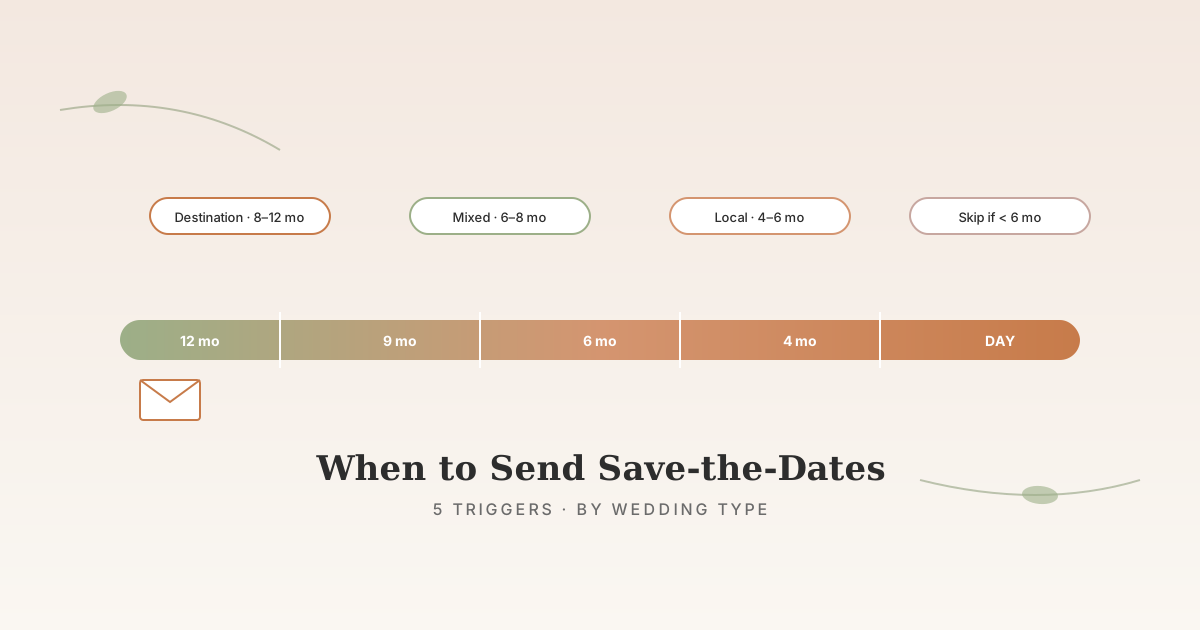
“6 to 12 months before the wedding” is the standard answer for when to send save-the-dates. The actually useful answer is which end of that range — and the five triggers that move you toward 12 vs 6. Below: the five triggers, the digital-first 2026 default, the “sent too early” failure mode (yes, it’s a real one), and the case for skipping save-the-dates entirely.
Quick baseline
- Local wedding, low-travel guests: 4-6 months out.
- Mixed local + travel guests: 6-8 months out.
- Destination or holiday weekend: 8-12 months out.
That’s the SERP consensus. Now the corrections.
5 triggers that push toward the early end (8-12 months)
- Hotel block in a high-demand window. If your wedding overlaps a city’s festival, sports championship, graduation weekend, or peak tourist season, hotel rooms book 9-12 months out. Send STDs while your block is still negotiating power.
- International / overseas guests. Even one international guest pushes you to 12 months — flight prices, passport renewals, vacation requests for non-US employees all need lead time.
- Major holiday weekend. Memorial Day, Labor Day, Fourth of July weekend, Thanksgiving weekend. Guests have existing traditions on these weekends. 11-12 months of notice lets them displace or commit consciously.
- Multi-day wedding weekend. Welcome drinks Friday + wedding Saturday + brunch Sunday isn’t one day off work — it’s a long weekend. Guests need to plan around it.
- Your bridal party is geographically scattered. Bridesmaids / groomsmen flying in for the wedding need to plan their travel as separate from any pre-wedding events (bachelorette, shower). Early STDs to the bridal party specifically prevent the “wait, I’m supposed to be there twice?” scramble.
Zero triggers active → 4-6 months is fine. One or two triggers → 6-8 months. Three or more triggers → push to 9-12 months.
The digital-first 2026 default
For most modern weddings, the right move is to send a digital save-the-date (email or wedding-website link) early, and follow with a printed STD if you want one. Three reasons:
- Speed. Digital can ship the day after engagement; print takes 2-4 weeks of design + printing + mailing.
- Address accuracy. Roughly 5-10% of paper STDs return undeliverable. Digital surfaces address-missing guests immediately so you can chase updates.
- Two-stage option. Send digital at month 9-10, send physical at month 6-7 when venue / design is locked. Print becomes a souvenir, not the informational piece.
The “sent too early” failure mode
Past 12 months out, save-the-dates start to backfire. Guests forget. The wedding loses urgency. By the time the actual invitation arrives, the original save-the-date is no longer front-of-mind — and any details have changed in the intervening 12+ months anyway. The wedding-industrial complex sometimes pushes 14-16 month STDs for “destination weddings.” Don’t. 11-12 months is the practical ceiling.
When to skip save-the-dates entirely
- Wedding is under 6 months out. Invitations (sent 6-10 weeks before) handle notice on their own. STDs at < 6 months out overlap awkwardly with invitation timing. See wedding timeline under 6 months.
- Wedding under 30 guests. Text, call, or DM each guest personally. Far better than a printed STD at this scale — and it’s the level of warmth small weddings should preserve.
- Elopement with reception later. STDs are for the reception only; the elopement is private. Sending STDs for the elopement itself confuses people about whether they’re invited.
What to put on the save-the-date
Names, date, city (not specific venue if you haven’t locked it), wedding-website URL, and “formal invitation to follow.” That’s it. Do not put: dress code, reception address, hotel block details, registry info. All of those belong on the wedding website or the formal invitation. For the full info-routing matrix across STD, invitation, website, and info card, see save-the-date vs invitation routing.
Design and send in 20 minutes
For a browser-built save-the-date with four template designs, photo upload, and print-ready PNG export, use the save-the-date generator. For 12 ready-to-copy wording templates by tone, see save-the-date wording templates.
Where this advice breaks
Cultural weddings with multi-day pre-wedding events (sangeet, mehndi, henna, garba, aufruf) operate on a different timeline — the entire family system gets oral notice through family elders earlier than any STD, and the printed STD functions more as a souvenir than as informational. In those contexts, ignore the trigger framework above; defer to family coordinators on timing.