How to Have the Wedding Budget Conversation With Parents (3 Family Shapes, 3 Scripts)
United, split, asymmetric — three family shapes, three different scripts. Plus the written follow-up that prevents retroactive string-attaching, and how to handle a parental no.
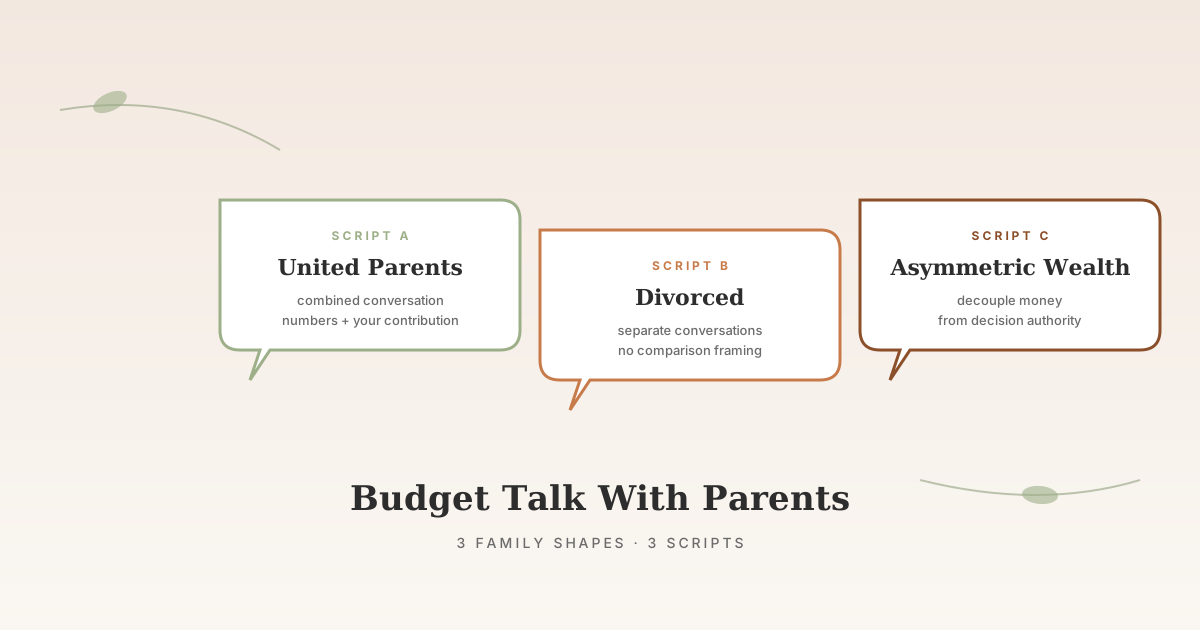
The wedding-budget conversation is a different conversation in three family shapes — united, split, and asymmetric — and the standard one-size script (be prepared, lead with vision, be grateful) under-equips the harder versions. Below: the three family-shape scripts, the written follow-up template that prevents retroactive string-attaching, and what to actually do when parents say no.
Before the conversation — what you need locked
- Your own number first. What you and your partner can contribute from your own savings. Don’t walk in without it — the conversation rotates around what you’re asking parents to add, which requires knowing your own contribution.
- A realistic total budget. Researched for your specific region and guest count. The number should pass a smell test with the parents — a wildly ambitious budget signals you haven’t done the math.
- One specific thing you’d use a parent contribution for. “Help us afford the photographer” lands better than “help us with the wedding.” Concrete asks are easier to say yes to than open-ended ones.
Script A — United parents (both of yours, both of theirs)
The easiest case but most common. Both sides intact, both engaged, similar financial capacity. Have one combined conversation if possible (in person, no kids/dogs/work to interrupt) rather than serial one-on-ones.
“We’re thinking about a [date] wedding for roughly [guest count] people, total budget around $[number]. We can put $[number] toward that ourselves. We wanted to ask if either of you would be in a position to help with part of it — and to be open about what that might look like on your side. We’re not asking for an answer today, just starting the conversation.”
Three things this script does: presents a number (so they can react), names your own contribution (so they don’t feel asked to fund 100%), and gives them an out today (so they don’t feel pressured).
Script B — Split family (divorced parents)
Have the conversations separately. Same script, but explicitly removing any “the other side is doing X” framing — divorced parents often compete in unhelpful ways when they hear about each other’s offers.
“Dad, I want to talk about the wedding. We’re aiming at $[total]. We can do $[our number]. I’d love to know if you’d be able to help with part of it. Whatever you can do is whatever you can do — I don’t want this to be a comparison thing, with Mom or with anyone. Whatever you’re comfortable with is what I’m asking.”
The most important sentence is “I don’t want this to be a comparison thing.” Say it explicitly. Divorced parents will compare anyway, but you’ve removed your permission for them to. Pair this with the seating-chart framework in wedding seating chart rules — divorced parents need parallel-but-separate handling throughout the wedding, not just at the budget conversation.
Script C — Asymmetric-wealth families
One side is meaningfully wealthier. The conversation needs explicit decoupling of contribution amount from wedding-decision authority.
“Before we discuss numbers — we want to be clear that whoever contributes what isn’t about the wedding decisions. We’re going to make those together as a couple. If you contribute $X and the other side contributes $0, that’s the contribution — there’s no veto rights bundled with it. We just want to be upfront about how this is going to work.”
Skipping this conversation is the single most common cause of wedding-budget friction in asymmetric families. The wealthier side later assumes editing rights they were never explicitly given; the less-wealthy side feels marginalised; the couple spends six months mediating. Pay the upfront awkwardness cost now.
The written follow-up — the under-used move
Within 24-48 hours of the verbal conversation, send a short written follow-up to each contributing party. Specific purpose: lock in the verbal agreement before it drifts.
“Hi Mom and Dad, thanks for the conversation last night. Just to summarise so we’re all on the same page: you’re comfortable contributing $[amount] toward the wedding, and there’s no specific use or condition attached / OR you’d like that to go toward [specific thing]. Let me know if I’ve gotten anything wrong. Really appreciate it.”
Sounds formal; saves arguments six months later when the contributing parent suddenly remembers there was a string they forgot to mention. The written version is also your evidence — even unconsciously, parents who put it in writing tend to honour what they wrote.
When parents say no
Three reactions to avoid:
- Don’t negotiate. Once parents have said they can’t, asking for a smaller amount the next week reads as transactional. Accept the answer cleanly.
- Don’t share frustration with the other side. Even if your in-laws’ contribution is meaningfully larger, don’t let it become a complaint topic between you and your partner. The disparity is a fact, not a grievance.
- Don’t resize the wedding to spite the no. Some couples respond to a parental no by scaling up the wedding to prove they didn’t need help. Don’t. The right response to a no is to revise the budget toward what your own contribution can fund cleanly — see who pays for what: the modern split for what couple-funded weddings look like in 2026.
Calculate before you negotiate
Run the traditional vs modern split side-by-side in the who pays calculator before the family conversation. Walking in with the numbers for both options demonstrates you’ve thought about the choices. For total cost expectations, see wedding cost breakdown 2026.
Where these scripts break
Two cases. First, families with cultural norms that treat the wedding as a family obligation rather than a couple-led project — many South Asian, Persian, and observant religious families operate this way. The script assumes you have authority over the spending; in those contexts that’s a negotiation itself before the budget conversation can happen. Defer to family elders / cultural-fluent advisors. Second, families where money has historically been a control mechanism (a parent who has used past financial help to extract obedience). These conversations should happen with a therapist’s coaching, not by following a script written for healthy family dynamics.