Who Pays for What at a Wedding — The 4 Modern Splits (2026)
Beyond the traditional 'bride's family pays' framework — the four modern split patterns (couple-funded, parent contribution, equal thirds, line-item) and the friction point each one creates.
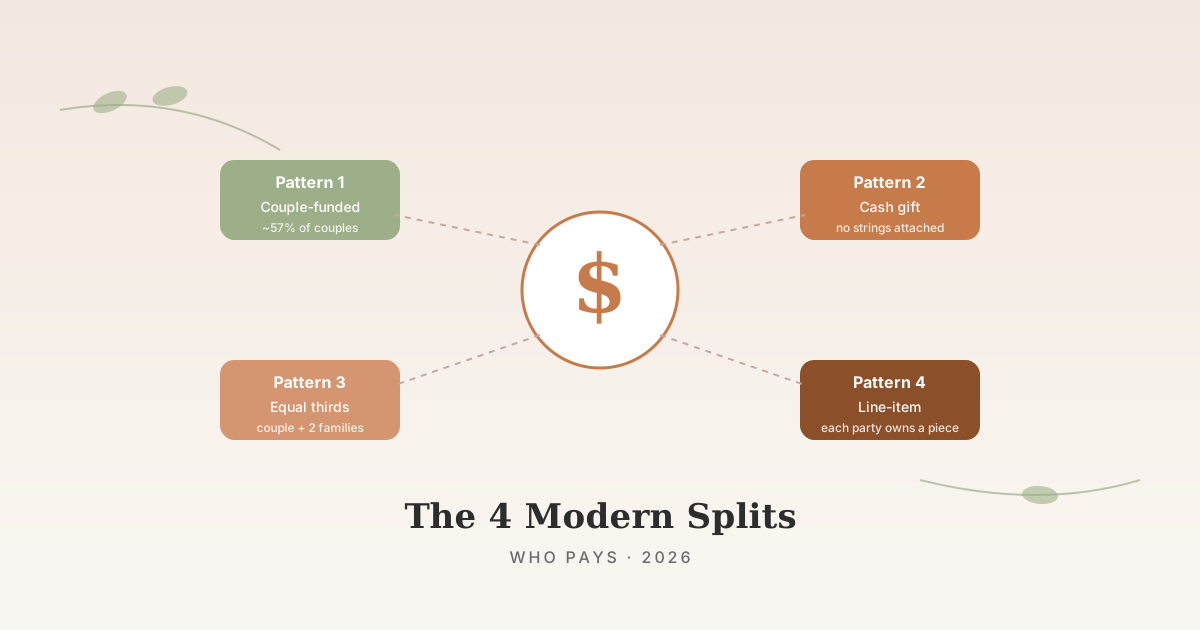
In 2026, the traditional “bride’s family pays for the wedding” framework is followed by roughly 1 in 5 couples. The other 80% follow one of four modern split patterns — and each comes with a predictable friction point. Knowing which split you’re actually doing (vs the one you’re telling people you’re doing) is the difference between a smooth budget conversation and a six-month family argument.
The traditional list, for reference
Mostly historical now, but useful as the baseline people are either following or diverging from. The traditional US split: bride’s family pays venue, catering, reception, flowers, photographer, bridal attire, invitations, and the wedding planner. Groom’s family pays the rehearsal dinner, officiant fee, marriage licence, honeymoon, and the couple’s rings. Roughly 60-70% of total budget falls on the bride’s side. This split survives in some traditional families and observant religious contexts but is not the modern default.
The 4 modern split patterns
Pattern 1 — Couple-funded (the most common now)
Who pays: The couple funds the entire wedding from their savings. Parents may give cash gifts but with no strings attached and no line-item ownership.
When it fits: Couples marrying in their late 20s or 30s, both employed, with combined savings of at least 1.5× the wedding budget. Couples who want complete creative control. Couples with families who explicitly cannot or do not contribute.
Friction point:The guest list. When parents contribute zero, they also lose social leverage over who gets invited. Tensions show up around family-friend invites, parents’ coworkers, and the plus-ones rule. Have the “guest list is ours to set” conversation early and explicitly.
Pattern 2 — Parent contribution (lump-sum cash gift)
Who pays: One or both sets of parents give a fixed cash amount toward the wedding. The couple budgets and spends it. No line items, no veto power over specific decisions.
When it fits:Parents who want to help but don’t want to manage. Couples who want flexibility but appreciate the financial cushion. Different contribution amounts from each side are normal here and don’t imply different stakes — the gift is what it is.
Friction point: Parents who give a lump sum and then later attempt to attach conditions retroactively (“but we thought you’d use it for the church we got married in”). Defuse upfront: when you accept the gift, restate the no-strings premise. Get it in writing if your family communicates poorly about money.
Pattern 3 — Equal thirds
Who pays:The couple, the bride’s family, and the groom’s family each cover roughly one-third of the total budget. Each “side” has soft input on its third.
When it fits: Families with similar financial capacity who want to share wedding ownership symbolically as well as financially. Couples whose own savings cover one third comfortably.
Friction point: Asymmetric family wealth. When one side genuinely cannot match a third, the “equal” framing creates shame. Pattern 3 is the right framing only when both families can comfortably do it. Otherwise default to pattern 2 with different gift amounts.
Pattern 4 — Line-item assignment
Who pays:Specific wedding categories are assigned to specific parties. Bride’s family pays the venue, groom’s family pays the rehearsal dinner and honeymoon, couple pays photography and flowers, etc. Each party owns their item.
When it fits: Families who want explicit involvement and ownership of a specific piece. Often blends traditional categories with modern reassignment.
Friction point:Pattern 4 carries the most veto risk. The party paying for the venue feels entitled to opinions on the venue. Mostly fine when the opinions are mild; corrosive when the family member with veto wants a different venue than the couple. Mitigate by writing a one-page “decisions are the couple’s; the funding party is informed, not consulting” document before money exchanges. Sounds formal; saves friendships.
How to actually have this conversation
Have it once, all parties at the table or on the call. Not in sequential one-on-ones — that breeds different versions of the agreement. The agenda is three questions, in order:
- What can each party comfortably contribute? Numbers, not vibes. “Up to $15k from us, we’re not stretching past that.”
- Which pattern do those numbers fit? The pattern follows the money, not the other way around.
- What expectations come with each contribution? This is the conversation people skip. Even “no strings” benefits from being said out loud.
Calculate the split
The who pays calculator shows the traditional split and the modern alternatives side-by-side for your specific budget — useful for the money-conversation meeting because it puts numbers, not adjectives, in front of everyone. For overall budget expectations, see wedding cost breakdown 2026; for cuts that don’t change guest experience, wedding vendor upsells to avoid is the post that pairs best with this one.
Where these patterns break
Three contexts. First: in many traditional South Asian, Persian, and observant Muslim weddings, the family-pays framework is woven into the religious / cultural meaning of the event, and the four-patterns model imposes a US-default framing that doesn’t fit. Defer to family elders and religious norms. Second: same-sex weddings sometimes find none of the patterns load-bearing because traditional gender-based splits don’t apply by definition; pattern 1 or 2 is usually the cleanest. Third: weddings that combine cultures often need a hybrid — pattern 2 from one side (cash gift, no strings) and pattern 4 from the other (rehearsal dinner owned outright). The patterns can mix.