How to Test a Wedding Color Palette Before You Book Vendors
Seven steps to test a wedding palette in venue light, across dye lots, on real skin, before you commit. With the three specific failure modes the test catches.
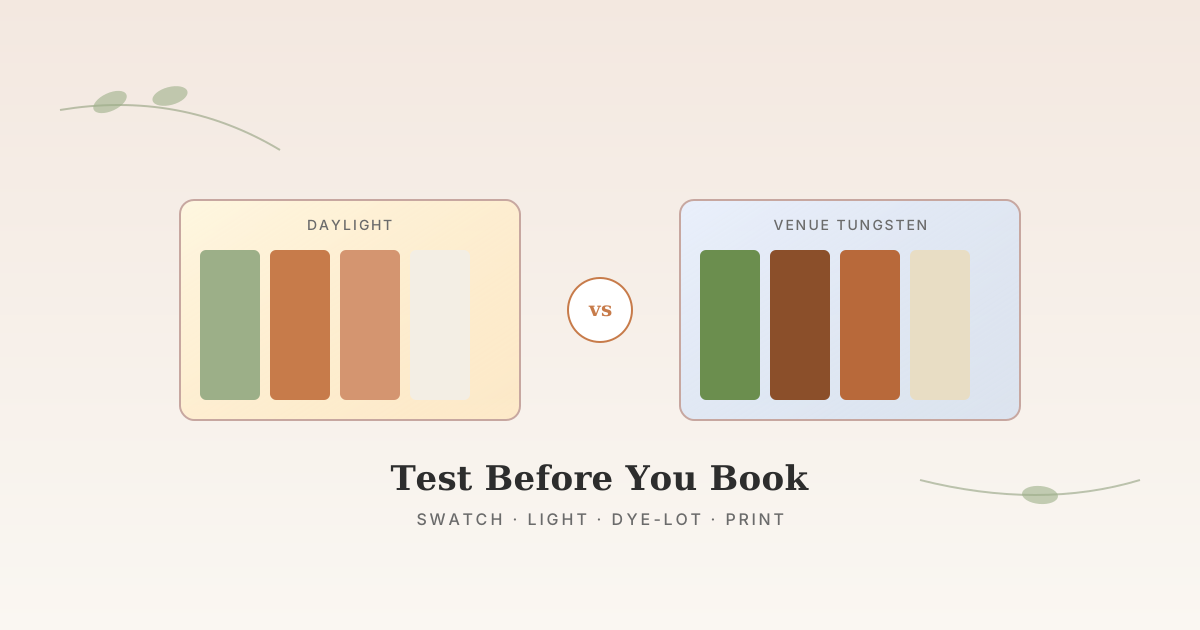
Most wedding palette regrets are not bad palettes — they are un-tested palettes. A bride picks two HEX codes from a moodboard, sends them to the florist, the bridesmaid dress site, and the print designer. Three months later, in the venue’s actual light, the sage reads grey, the dusty blue reads navy, and the bridesmaid dresses arrive in three visibly different shades. The seven-step test below — done before you book any colour-dependent vendor — costs about three weeks of swatches and $80 in shipping, and prevents the entire failure mode.
The 7 steps, in order
- Lock the HEX, then the Pantone. Pick exact HEX codes (not adjectives). Cross-reference each to the nearest coated and uncoated Pantone — coated for ribbons / linens / signage, uncoated for invitation paper. “Sage” ranges from #9CAF88 to #6B8E4E across retailers; lock one specific shade and refer to it by HEX in every vendor email.
- Order fabric swatches from 2-3 retailers. For each palette color, order at least one chiffon swatch and one satin swatch from each retailer you’re considering for bridesmaid dresses (Azazie, Birdy Grey, Revelry, BHLDN). Chiffon takes dye 5-10% lighter than satin in the same dye lot; retailers vary by another 5-15%. Total cost: $25-50 for 8-12 swatches.
- Test in venue light, not your kitchen. Visit the venue mid-week, in the same time-of-day slot your ceremony will run. Lay the swatches on the table linens. Tungsten uplights pull blues and sages cooler; halogen pulls everything warmer; LED varies by chip temperature. Take phone photos with flash off — the photos are the second test, not the eye.
- Photo-test against skin tones. Drape a swatch under your chin in the venue’s mirror, then on each of your bridesmaids if possible. Sage flatters most skin tones; cool dusty blue washes out pale skin; rich terracotta clashes with redder undertones. The photo from step 3 plus this drape test catches 90% of color-on-skin problems.
- Order one full sample dress before bulk-ordering. Sample dress from your top retailer in your selected color + fabric. $80-150, takes 2 weeks. Receive it, photograph it in the venue light. If the sample matches the swatch, the dye lot is consistent enough to scale. If it doesn’t, you’ve just saved 5+ bridesmaids from non-returnable mismatched dresses.
- Print one sample invitation / sign. Send the print designer a single sample on your final paper. Screen → CMYK print drift is the second biggest palette disappointment after dye-lot variance — particularly for mauves and dusty blues, which can shift toward grey or navy on uncoated paper. Adjusting before the bulk run is 10× cheaper than reprinting.
- Generate the vendor brief PDF. One document with five swatches (HEX + Pantone coated + uncoated), three reference photos, and explicit “not these” counter-examples. Send it to every color-dependent vendor (florist, stationer, rentals, bridal party, signage). Verbal description “dusty blue” is where palette consistency dies.
Three ways the test fails (and what to do)
- Failure 1: Swatch looks great, sample dress looks wrong. The dye lot drifted. Don’t bulk-order from this retailer; either reorder a second sample (sometimes one lot is the outlier), or switch retailers. Don’t accept “close enough” — 5 dresses at “close enough” read as 5 different colors in group photos.
- Failure 2: Looks great in your kitchen, dies in venue light. The venue light is permanent, the palette isn’t. Shift half a shade warmer or cooler depending on the venue’s dominant light. For tungsten venues, push warm colors warmer and cool colors slightly warmer too (don’t go pure cool). For LED-dominant venues, neutralize toward the natural HEX.
- Failure 3: Skin-tone wash-out. If the dust-blue / blush / sage flattens your bridesmaids, add a neutral. The neutral can be cream, champagne, taupe, or dusty rose depending on the warm/cool axis of the primary. A neutral against the chin prevents the color from competing with skin.
Timing — when to run the test
Start the test 6 months before the wedding. Order swatches at month 6, run venue-light test at month 5.5, order sample dress at month 5, complete by month 4.5. This leaves a 6-week safety margin for re-ordering if the test fails — bridal-party dresses ship in 6-10 weeks from most retailers, plus 2 weeks of alterations, so under-6-months timelines miss this window entirely. For weddings under 6 months, skip the sample-dress step and accept dye-lot variance.
Speed up steps 1, 3, and 7
The wedding palette generator renders your two anchor HEXes across six in-context scenes (tablescape, bouquet, chairs, arch, invitation, bridesmaids) so the photo-test is approximated before you order any physical swatches. The same tool generates the vendor brief PDF from step 7 — HEX, Pantone, and reference imagery in one downloadable file. For specific tested palettes, see sage green palette and terracotta + sage — both are written with venue-light failure modes called out.
Where this test breaks
For micro-weddings under 25 guests, the cost of the full test often exceeds the savings — you’re ordering 2 bridesmaid dresses, not 8, and the print run is 30 invitations not 150. Drop steps 5 and 6 (sample dress, sample invitation) and rely on retailer return policy. For destination weddings where the venue light isn’t accessible pre-booking, ask the photographer for raw photos taken in the same season and time-of-day; they read more accurately than venue marketing photos.